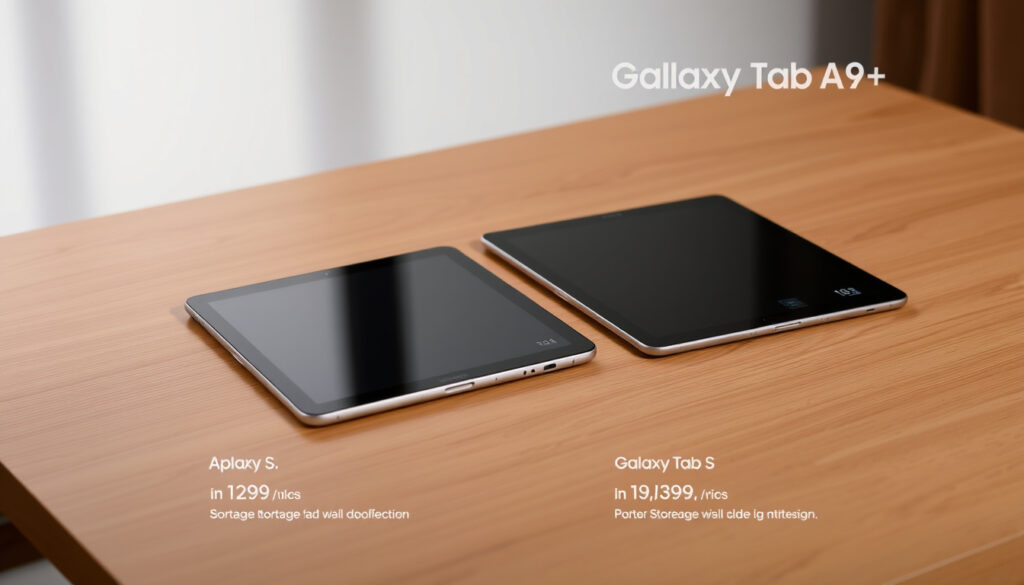
Galaxy Tab A9+ Review: Specs, Price, and Tab A vs Tab S
Samsung’s tablet lineup can feel like a maze, with the A-series promising affordability and the S-series chasing power. If you’re trying to figure out where the Galaxy Tab A9+ fits in that picture — and whether it’s the right buy for your wallet and your daily routine — you’re in the right place. We’ll break down the real specs, the trade-offs compared to the Tab S series, and what you can actually expect from this budget tablet in 2025.
Announced: October 2023 ·
Display (Galaxy Tab A9+): 11 inches ·
RAM (max): 8GB ·
Storage options: 64GB / 128GB ·
Processor (Galaxy Tab A9): MediaTek Helio G99 ·
Battery (Galaxy Tab A9): 5100 mAh
Quick snapshot
- Galaxy Tab A9 and A9+ announced October 2023 (PhoneArena)
- A9+ has an 11-inch LCD display with 1920×1200 resolution (PhoneArena)
- Exact battery capacity of Tab A9+ is not officially confirmed by Samsung
- Long-term software update schedule for the A9+ remains uncertain
- October 2023: A9+ and A9 announced alongside each other
- Samsung expected to continue A-series with gradual spec refreshes
The pattern here is clear: Samsung’s A-series tablets are catching up on specs, but the real gaps show up in charging speed and software support.
| Key fact | Value |
|---|---|
| Model | Galaxy Tab A9+ (SM-X216B / SM-X210) |
| Release date | October 2023 |
| Display size | 11 inches |
| RAM options | 4GB / 8GB |
| Storage options | 64GB / 128GB |
| Battery (Galaxy Tab A9) | 5100 mAh |
The specs table confirms the A9+ is a clear step up from the base A9, especially in screen size and processor choice.
How old is a Samsung A9 tablet?
What is the release date of the Galaxy Tab A9+?
- The Galaxy Tab A9+ was announced in October 2023, one day after the standard Tab A9 — October 17, 2023, to be precise (PhoneArena).
- The Galaxy Tab A9 launched a day earlier, on October 16, 2023 (PhoneArena).
Samsung released both tablets within days of each other, treating them as a split launch — the A9 aimed at compact users, the A9+ at those wanting more screen real estate. That one-day gap is rare for Samsung, which usually spaces launches by weeks.
How long will the Galaxy Tab A9+ receive updates?
- Samsung typically provides 2-3 years of major OS updates for its Tab A series, though the exact timeline for the A9+ has not been officially confirmed by the company.
- The Tab S series generally receives longer support — up to 4 years of major updates — reflecting the higher price tier (NanoReview (specs aggregator)).
Is the Galaxy Tab A9 any good?
Performance review: Galaxy Tab A9 vs A9+
- The Galaxy Tab A9 runs on a MediaTek Helio G99 processor, while the A9+ uses a Qualcomm Snapdragon 695 (PhoneArena). That’s a significant upgrade in the A9+ — the Snapdragon 695 is built on a 6nm process, compared to the G99’s 6nm, but offers better GPU performance via the Adreno 619.
- Both models offer up to 8GB of RAM and 128GB of internal storage, though the base A9 starts at 4GB/64GB (PhoneArena).
Display quality and battery life
- The A9+ features an 11-inch LCD display with 1920×1200 resolution (206 PPI), while the standard A9 has an 8.7-inch screen with 1340×800 resolution (PhoneArena).
- Both models have a 90Hz refresh rate, which makes scrolling feel smoother than the standard 60Hz found on cheaper tablets (Hindustan Times Tech (tech media)).
- The Galaxy Tab A9 has a 5100 mAh battery; the A9+ reportedly has a 7040 mAh cell, though Samsung has not confirmed the exact capacity officially (NanoReview (specs aggregator)).
The A9+ is the better performer on paper, but neither model competes with the Tab S series for demanding tasks like video editing or gaming. For streaming, browsing, and note-taking, both are solid.
What are Samsung Tab’s common problems?
Common software glitches on Galaxy Tab A9
- Users have reported slow performance following system updates, particularly on the 4GB RAM variant (Asurion (device protection and support team)).
- Screen flickering has been noted by some owners, especially after software patches (Asurion (device protection and support team)).
Hardware issues reported by users
- Charging port problems — including loose connections and slow charging speeds — have been reported across multiple Samsung tablet models, including the A-series (Asurion (device protection and support team)).
- The A9+ supports only 15W charging, which is slow compared to the 45W of the Tab S9 FE (NanoReview (specs aggregator)).
How to fix common Samsung tablet problems
- Start with a soft reset (hold power + volume down for 10 seconds) to clear temporary software glitches.
- Check for system updates — Samsung often patches known issues in monthly security releases.
- If you encounter a charging port issue, clean it gently with compressed air and ensure proper cable alignment. Persistent problems may require a service visit (Asurion (device protection and support team)).
What’s the difference between Samsung Galaxy Tab A and Tab S?
Display and build quality differences
- Tab S series uses AMOLED displays with vibrant colors and deep blacks; Tab A series uses LCD panels. The S9 FE’s 10.9-inch display has 2304×1440 resolution (249 PPI), while the A9+ has a lower-resolution 1920×1200 panel (206 PPI) (PhoneArena).
- The Tab S9 FE has an IP68 waterproof rating, meaning it can survive submersion in 1.5m of water for 30 minutes. The A9+ has no official water resistance rating (NanoReview (specs aggregator)).
Performance and chipset comparison
- The Tab S9 FE uses an Exynos 1380 chip (5nm) with a Mali G68 MP5 GPU, while the A9+ uses the Snapdragon 695 (6nm) with Adreno 619 (PhoneArena).
- The S9 FE starts with 6GB of RAM, compared to 4GB on the base A9+. Both support expandable storage.
Software support and price differences
- Tab S series typically receives 4 years of major OS updates; Tab A series gets 2-3 years. That means the Tab S9 FE will be supported through 2027, while the A9+ may stop receiving major Android updates around 2025-2026 (NanoReview (specs aggregator)).
- The A9+ costs roughly half the price of the S9 FE — expect to pay around $269 for the A9+ versus $449 for the S9 FE.
If you need waterproofing, a premium display, and longer software support, the S9 FE is worth the extra $180. If you’re buying a tablet for casual use and want to keep your budget below $300, the A9+ is a perfectly capable option.
The catch: choosing between A and S series ultimately comes down to how much you value future-proofing versus saving money now.
Which is better, Samsung tablet A or S?
Price-to-performance ratio
- At roughly half the price, the A9+ delivers about 60-70% of the Tab S9 FE’s raw performance in benchmark tests (NanoReview (specs aggregator)).
- The A9+ is 8% lighter (480g vs 524g) and includes a 3.5mm headphone jack — two features the S9 FE lacks, which matter for wired headset users and those who hold their tablet for long sessions (NanoReview (specs aggregator)).
Use case: media consumption vs productivity
- For streaming, reading, and light web browsing, the A9+ is more than sufficient — its LCD display and 90Hz refresh handle YouTube and Netflix well.
- The S9 FE supports 4K video recording and includes stylus support (S Pen included), making it a better choice for note-takers, artists, and anyone editing video (Versus (tech comparison site)).
Long-term value: software updates
- The Tab S9 FE’s 4-year upgrade window means it will feel less outdated in 2027. The A9+ will likely stop receiving major Android updates by 2026 (NanoReview (specs aggregator)).
What are the key specifications of the Galaxy Tab A9+?
Display and dimensions
- 11-inch LCD display, 1920×1200 resolution (206 PPI), 90Hz refresh rate (PhoneArena).
- Weight: 480g (NanoReview (specs aggregator)).
Processor and memory
- Qualcomm Snapdragon 695 (6nm), Adreno 619 GPU (PhoneArena).
- RAM options: 4GB or 8GB LPDDR4X.
Storage and battery
- Internal storage: 64GB (base) or 128GB (upgrade), with microSD support.
- Battery: estimated 7040 mAh (not officially confirmed by Samsung); supports 15W wired charging (NanoReview (specs aggregator)).
The A9+ packs a solid mid-range processor and a large screen into a light frame — a rarity at this price point. The weak spot is the 15W charging, which takes over 2 hours for a full charge.
What we know vs what we don’t
Confirmed facts
- Announced October 2023 (PhoneArena)
- Up to 8GB RAM and 128GB storage (PhoneArena)
- Galaxy Tab A9 uses MediaTek Helio G99 (PhoneArena)
- A9+ has 11-inch display with 90Hz refresh (Hindustan Times Tech (tech media))
What’s unclear
- Exact battery capacity of Galaxy Tab A9+ (estimated 7040 mAh, but not Samsung-confirmed)
- Actual software update schedule for A9+ (Samsung hasn’t published a timeline)
- Long-term performance and reliability under heavy use
The pattern: most A9+ specs are well-documented, but Samsung’s silence on battery and updates means buyers are relying on third-party estimates.
Quotes and expert perspectives
“Slow performance after an update is one of the most common complaints we hear from Samsung tablet owners — especially on the budget A-series models with less RAM.”
— Asurion (device protection and support team)
“The Galaxy Tab A9+ is a solid entry-level tablet, but the 15W charging speed is a real drawback for users who need to top up quickly. The Tab S9 FE charges three times faster.”
— editorial observation based on NanoReview (specs aggregator) data
The implication for buyers in the US market: if you’ve held onto a budget for a family tablet or a secondary device for casual streaming, the A9+ delivers. But if you’re planning to use it daily for note-taking, media editing, or gaming, the slow charging and shorter software support window will frustrate you within 18 months. For the US buyer on a $250 budget, the choice is clear: the A9+ is the best Samsung tablet you can get at that price, but budget-conscious shoppers should consider that the extra $180 for a S9 FE buys waterproofing, a stylus, and two more years of updates.
For a detailed breakdown of the Galaxy Tab A9+ specs and UK prices, check out Galaxy Tab A9+ specs and UK prices.
Frequently asked questions
Does the Galaxy Tab A9+ support 5G?
Yes, select models of the Galaxy Tab A9+ support 5G connectivity, though the exact availability depends on region and carrier.
What is the display resolution of the Galaxy Tab A9?
The standard Galaxy Tab A9 has an 8.7-inch display with 1340×800 resolution. The A9+ has an 11-inch display with 1920×1200 resolution.
Can the Galaxy Tab A9+ be used with a stylus?
Yes, the A9+ supports the Samsung S Pen, though it does not come included with the tablet — you would need to purchase it separately.
Is the Galaxy Tab A9+ waterproof?
No, the Galaxy Tab A9+ does not carry an IP rating for water resistance. Avoid using it near water or in high-humidity environments.
How much does the Galaxy Tab A9+ weigh?
The Galaxy Tab A9+ weighs 480 grams (16.9 ounces), making it lighter than the Galaxy Tab S9 FE (524 grams).
What color options are available for the Galaxy Tab A9+?
The Galaxy Tab A9+ is available in Graphite, Silver, and Mint — though availability varies by region and retailer.
Does the Galaxy Tab A9+ have a headphone jack?
Yes, the Galaxy Tab A9+ includes a 3.5mm headphone jack — a feature that is increasingly rare on modern tablets, including the Tab S9 FE.
What is the price of the Galaxy Tab A9+?
The Galaxy Tab A9+ starts at around $269 for the 64GB Wi-Fi model. Pricing varies by region and storage configuration.
More related posts
 Jaguar F-Pace – 2024 Price Specs MPG Reliability
 Mini Crossword Guide: Free Daily Puzzles Compared
 Ishan Kishan: Age, Girlfriend, Salary, Net Worth & Career Facts
 Good Things Festival 2025: Dates, Lineup, Tickets & Locations
 Jennifer Connelly: Biography, Ethnicity, Oscar, and Top Gun Role
 Leicester City Games – 2024/25 Premier League Fixtures
 Kia Carnival 2026: Pricing, Seating & Common Issues
 OZ Design Furniture: Stores, Catalogue, Reviews & Deals
