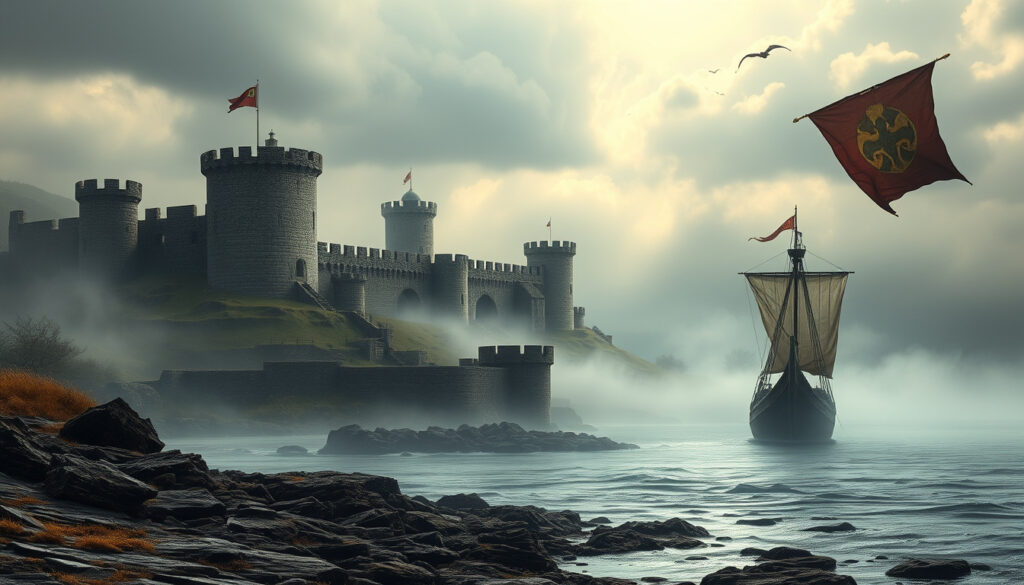
The Last Kingdom – Complete Guide to Seasons, Cast and Sequel
The Last Kingdom stands as one of the most acclaimed historical drama series of the past decade, weaving together the brutal politics of ninth-century England with deeply personal stories of identity and loyalty. Running from 2015 to 2022 across five seasons, the show brought Bernard Cornwell’s beloved Saxon Stories to life on screens worldwide. Netflix eventually became the home for all seasons, introducing the series to an expanded global audience following its initial broadcast run on BBC Two in the United Kingdom.
At its core, the series follows Uhtred of Bebbanburg, a man perpetually caught between two worlds. Born Saxon but raised by Viking warriors after his father was killed and his home seized, Uhtred’s journey spans decades of conflict as English kingdoms clashed with Danish invaders. The show earned praise for its grounded approach to medieval warfare, nuanced portrayals of historical figures like King Alfred, and its refusal to reduce complex political situations to simple moral binaries. Viewers who appreciate detailed character studies in historical settings often find themselves drawn into the saga’s five-season arc.
Following the series conclusion, Netflix released a sequel film titled Seven Kings Must Die in 2023, offering closure for the character arcs established throughout the television run. This continuation brought certain storylines to their historical endpoint while preserving the franchise’s signature blend of action and political intrigue.
What Is The Last Kingdom About?
The Last Kingdom chronicles the turbulent period of English history when the island of Britain remained divided among warring kingdoms. The narrative centers on Uhtred of Bebbanburg, who begins his journey as a young boy watching Danish raiders destroy his home and kill his father. Taken as a thrall by the Viking warlord Ragnar the Younger, Uhtred grows up immersed in Danish culture, learning their language, customs, and combat techniques. This dual upbringing becomes the source of Uhtred’s lifelong struggle—his heart belongs to the Danes who raised him, yet his birthright lies with the Saxons who abandoned him.
Plot Summary
When adult Uhtred finally gains his freedom, he discovers that his ancestral home of Bebbanburg remains occupied by his scheming uncle. This betrayal sets him on a path that increasingly intertwines his fate with the Saxons, particularly through his complicated relationship with King Alfred of Wessex. Alfred sees Uhtred as a valuable weapon against the Danish threat, while Uhtred views the king as an obstacle to reclaiming his birthright. Their reluctant partnership drives much of the early narrative, with Uhtred serving as a warrior and strategist while privately maintaining his pagan beliefs and Danish loyalties.
The series expands beyond Wessex to include the kingdoms of Northumbria and Mercia, showing how various rulers and peoples navigated the ever-present threat of Viking conquest. Characters like Lady Aethelflaed of Mercia evolve from supporting figures to powerful leaders in their own right, reflecting the show’s commitment to historical complexity. Battles feature prominently throughout the series, but quieter moments of political maneuvering, marriage negotiations, and religious conflict prove equally consequential to the story’s outcome.
Number of Seasons and Episodes
Each season adapts portions of Cornwell’s book series, with the narrative structured around escalating conflicts and shifting allegiances. The final season brings several major storylines toward their conclusion, though certain threads extend into the theatrical film released the following year.
- The series premiered on BBC Two before Netflix acquired global streaming rights
- Alexander Dreymon portrayed Uhtred across all five seasons and the 2023 film
- Multiple cast members appeared from the beginning through the series finale
- The show maintained relatively consistent critical reception throughout its run
- Filming took place primarily in Hungary and the United Kingdom
- Production concluded in 2022 after BBC and Netflix jointly decided not to renew the series
- Netflix released Seven Kings Must Die as a theatrical continuation of the story
| Detail | Information |
|---|---|
| Genre | Historical Drama, Action |
| Lead Actor | Alexander Dreymon |
| Series Creator | Stephen Butchard |
| Executive Producers | Gareth Neame, Nigel Marchant |
| Original Network | BBC Two (UK), Netflix (International) |
| Final Season Release | 2022 |
| Source Material | The Saxon Stories by Bernard Cornwell |
| Sequel Film | Seven Kings Must Die (2023) |
Is The Last Kingdom Based on a True Story?
The Last Kingdom draws its foundation from Bernard Cornwell’s Saxon Stories book series, which themselves weave together documented historical events with a fictional protagonist. Uhtred of Bebbanburg never existed as a real historical figure, but the conflicts, battles, and political maneuvering that surround him reflect actual ninth-century history. The Danish invasions of England, the rise of King Alfred and his descendants, and the eventual unification of English kingdoms under Æthelstan all form part of the historical record that inspired the novels and their television adaptation.
Source Material
Cornwell’s Saxon Stories comprise fourteen novels published between 2004 and 2020, chronicling the imagined life of a Bebbanburg warrior navigating the Viking Age. The books are known for their vivid depictions of medieval combat and their thoughtful exploration of how competing cultures and religions shaped the British Isles. Cornwell, who grew up in London and later taught in the United States, has spoken extensively about his approach to blending fact and fiction, typically using real historical figures and events as anchors while creating fictional characters to serve as witnesses and participants.
The television adaptation condenses and rearranges material from multiple books across each season. Certain characters, like Æthelred of Mercia and Bishop Heahmund, combine traits from multiple historical sources or take liberties with the historical record. Fans of the books often note that the show diverges increasingly from its source material in later seasons, particularly regarding character fates and relationship dynamics.
Historical Events and Fiction
Real historical events depicted in the series include the Battle of Edington in 878, which marked a turning point in Alfred’s resistance against the Danes, and the eventual succession crisis following Alfred’s death. The show’s treatment of figures like King Alfred, Lady Æthelflæd, and Æthelstan draws from Anglo-Saxon chronicles and later medieval histories. However, the specific events of Uhtred’s life, his personal vendettas, and his romantic relationships remain products of Cornwell’s imagination.
While The Last Kingdom presents itself as grounded in history, viewers should understand that the central character’s adventures and many supporting character storylines represent fiction. The show uses real historical figures and documented events as its framework, but the emotional core of the narrative belongs to the novels’ imagined protagonist.
The series maintains stronger historical accuracy in its depictions of warfare, social structures, and religious practices than in its character-level storytelling. Military tactics, siege warfare, and the material culture of both Saxon and Danish communities reflect research into the period’s archaeology and historical records.
Is There a Season 6 of The Last Kingdom?
The Last Kingdom concluded with its fifth season in 2022, and no additional television seasons are currently planned. The production team, led by executive producers Gareth Neame and Nigel Marchant, determined that the story had reached a natural endpoint suitable for the screen adaptation. This decision marked the end of a television project that had run for seven years across the BBC and Netflix.
Season 5 Ending
The final season brought several major narrative threads to their conclusions, though viewers familiar with the source material will recognize that Cornwell’s book series continues beyond the television adaptation’s stopping point. Uhtred’s pursuit of his birthright, the political machinations surrounding the succession of Wessex, and the ongoing tensions between Saxon and Danish populations all receive substantial development in the fifth season. The finale provides emotional resolution for the central character while acknowledging that historical forces continue to shape the world beyond the frame of the story.
Several actors who appeared throughout the series received significant focus in these final episodes, with their characters’ arcs reaching destinations that varied considerably in tone. The show maintained its tradition of combining intimate character moments with sweeping historical drama through its concluding hours.
Seven Kings Must Die Film
Seven Kings Must Die serves as a direct continuation of the television series, picking up threads left open by the fifth season and bringing them toward historical conclusions. The film debuted on Netflix in 2023, reuniting director and much of the principal cast for a theatrical-length story. Ewan Horrocks returned as Prince Aelfweard, whose uncertain claim to the throne drives much of the narrative tension.
The film attempts to provide closure that the television series could not offer, given its decision to end after five seasons. For viewers seeking additional time with these characters, the continuation represents the final chapter of their screen story, though it cannot encompass the full scope of Cornwell’s remaining books.
Viewers should complete all five seasons before watching Seven Kings Must Die, as the film assumes familiarity with the characters and their relationships developed throughout the series. The narrative directly continues from the season five finale.
Who Plays Uhtred in The Last Kingdom?
Alexander Dreymon portrays Uhtred of Bebbanburg throughout the series’ entire run, including the 2023 sequel film. The German-American actor took on the demanding role of the morally complex protagonist who serves as the audience’s primary perspective on ninth-century England. Dreymon trained extensively in historical combat techniques to perform the role’s numerous fight sequences, often performing stunts himself rather than relying on stunt doubles.
Main Cast List
The ensemble cast brings together performers from diverse backgrounds, reflecting the show’s international production and its thematic interest in cultural boundaries. Several supporting actors appeared across multiple seasons, their characters growing and changing alongside the central narrative.
- Alexander Dreymon as Uhtred of Bebbanburg, the Saxon-born warrior raised by Danes
- Emily Cox as Brida, Uhtred’s former companion whose loyalties shift throughout the series
- Timothy Innes as King Edward, Alfred’s heir who becomes king of Wessex
- Millie Brady as Lady Æthelflæd, who evolves from princess to ruler of Mercia
- Eliza Butterworth as Ælswith, whose animosity toward Uhtred becomes a recurring tension
- Mark Rowley as Finan, Uhtred’s Irish companion who provides comic relief
- Arnas Fedaravičius as Sihtric, Uhtred’s close friend introduced in the second season
- Adrian Schiller as Æthelhelm, a political operator whose influence extends across seasons
Additional recurring performers contributed significantly to the show’s ensemble quality. Magnus Bruun appeared as Cnut during the third and fourth seasons, while Eysteinn Sigurðarson portrayed Sigtryggr, a character whose actions reshape the political landscape of Northumbria. Thea Sofie Loch Næss played the seer Skade, whose presence affects multiple characters’ decisions and fates.
Rutger Hauer appeared in the first season as Ravn, a figure whose relationship with young Uhtred establishes themes that resonate throughout the entire series. Matthew Macfadyen portrayed Lord Uhtred of Bebbanburg in early seasons, grounding the protagonist’s backstory in recognizable family drama. You can read more about ensemble casts in Cast of Supernatural for comparison with other long-running series.
Where Was The Last Kingdom Filmed?
The production utilized locations across multiple countries to recreate the varied landscapes of ninth-century Britain. Hungary served as the primary filming location, with its architecture and terrain providing convincing stand-ins for English and Scandinavian settings. The country’s medieval towns and rural expanses offered the production flexibility to depict everything from fortified settlements to open battlefields.
Key Locations
Filming in Hungary allowed the production to construct elaborate sets that would have proven prohibitively expensive in the United Kingdom alone. The series built extensive Viking and Saxon settlements on soundstages and outdoor locations, creating environments that could be reused and modified across multiple seasons. This approach helped maintain visual consistency while managing the budget constraints typical of historical drama production.
Additional filming took place in the United Kingdom, particularly for sequences requiring specifically English landscapes or architecture. The combination of Hungarian and British locations enabled the show to capture the geographic diversity of the period while staying within practical production parameters. Post-production visual effects supplemented practical locations, adding period-appropriate structures and atmospheric elements to create the impression of a fully realized historical world.
The specific details of filming locations beyond Hungary and the United Kingdom are not extensively documented in available sources. Additional filming destinations may exist but remain unconfirmed in the public record.
The Last Kingdom Timeline
The development of The Last Kingdom from novel series to television phenomenon spans nearly two decades, with key milestones marking its progress from page to screen and its subsequent expansion across platforms.
- Bernard Cornwell publishes the first Saxon Stories novel
- The Last Kingdom premieres on BBC Two
- Second and third seasons announced, production moves to Hungary
- Netflix acquires international streaming rights
- Fifth season concludes, marking the series finale
- Seven Kings Must Die theatrical film released on Netflix
Confirmed Information and Remaining Uncertainties
The Last Kingdom’s production history includes both well-documented facts and areas where information remains limited or unavailable. Understanding what is established versus what remains unclear helps viewers approach the series and its context appropriately.
| Confirmed | Not Fully Established |
|---|---|
| Five seasons produced, 2015–2022 | Complete filming location details |
| Alexander Dreymon starred throughout | Specific budget figures |
| Based on Bernard Cornwell’s Saxon Stories | Detailed production challenges |
| Netflix released sequel film in 2023 | Full extent of planned future projects |
| BBC Two original UK broadcaster | Comprehensive historical accuracy analysis |
| Series concluded without renewal | Complete list of filming locations by season |
Historical Context and Comparisons
The Last Kingdom emerged during a period of renewed popular interest in Viking Age history, following the success of other historical dramas exploring similar terrain. The series distinguishes itself through its focus on the English perspective rather than Viking protagonists, offering viewers a nuanced view of the conflict between Saxon and Danish cultures. The show’s treatment of King Alfred and his descendants reflects contemporary historical scholarship that has complicated earlier, simpler narratives about the period.
While The Last Kingdom shares its general time period with other historical dramas, it operates independently of other franchises. The series drew comparisons during its broadcast run to programs featuring Norse mythology and Viking culture, though viewers should understand that no direct connection exists between these separate productions. Each maintains its own continuity, characters, and creative approach despite occasionally depicting overlapping historical events.
Sources and Perspectives
The production of The Last Kingdom involved collaboration between BBC and Netflix, with executive producers Gareth Neame and Nigel Marchant overseeing development across multiple seasons. The creative team worked closely with Bernard Cornwell to adapt his book series, balancing fidelity to source material with the demands of visual storytelling.
The series represents a significant adaptation of my work, bringing the Saxon Stories to an audience far beyond those who read the books. The production team has shown genuine commitment to capturing the spirit of the period.
— Bernard Cornwell, author of The Saxon Stories
Additional information about the books and the author can be found at Bernard Cornwell’s official website, which provides context for the source material’s creation and development.
Summary: Understanding The Last Kingdom’s Legacy
The Last Kingdom carved out a distinctive place in the landscape of historical television drama, offering viewers a sustained narrative that prioritized character complexity over simplistic heroism. Across five seasons and forty-six episodes, the series explored themes of identity, loyalty, and nation-building that resonated with contemporary audiences despite its medieval setting. The decision to conclude after five seasons, followed by a theatrical film, provided a measure of closure while acknowledging that some stories extend beyond what any adaptation can encompass.
For viewers seeking historical drama that balances action with political nuance, The Last Kingdom represents a significant achievement in the genre. Its adaptation of Cornwell’s novels demonstrates both the possibilities and limitations of translating literary narrative to screen, with the final product standing as a substantial achievement in its own right. Those interested in exploring similar themes might also consider Poor Things Movie Guide for another perspective on period storytelling.
Frequently Asked Questions
Is The Last Kingdom related to the Vikings TV series?
No direct connection exists between The Last Kingdom and the separate Vikings television series. Both depict Viking Age history but feature entirely different characters, storylines, and creative teams. The Last Kingdom focuses on English perspectives during the period of Danish invasions.
How many books are in the Saxon Stories series?
The Saxon Stories comprise fourteen novels published between 2004 and 2020. The television adaptation covers approximately the first ten books, with the final novels remaining unadapted for the screen.
Will there be more The Last Kingdom content?
As of current information, no additional television seasons are planned. Seven Kings Must Die serves as the final screen continuation, though Bernard Cornwell has continued publishing related works.
Where can I watch The Last Kingdom?
All five seasons and the Seven Kings Must Die film are available on Netflix in most regions. The series originally aired on BBC Two in the United Kingdom before transitioning to Netflix for international distribution.
Did Alexander Dreymon do his own stunts?
Alexander Dreymon trained extensively in historical combat techniques and performed many of his own fight sequences throughout the series. Reports indicate he often preferred to perform stunts himself rather than use doubles when possible.
Is Uhtred of Bebbanburg a real historical figure?
No, Uhtred of Bebbanburg is entirely fictional, created by Bernard Cornwell for his novel series. The historical setting, including figures like King Alfred and the battles of the period, is based on documented history.
More related posts
 Richard Griffiths: Medical Condition, Cause of Death, and Relationship with Daniel Radcliffe
 Jaguar F-Pace – 2024 Price Specs MPG Reliability
 Prince Harry: Latest News, Condition, and Family Updates
 Mary Berry: Her Polio, Son’s Death, and Family Life
 Ivan the Terrible: Russia’s First Tsar, Reforms & Legacy
 Attila the Hun: Biography, Empire, Death, and Legacy
 Grand Chancellor Hobart – Reviews, Ratings and Location Guide
 Interest Rate Cuts Banks – How They Squeeze Profits
