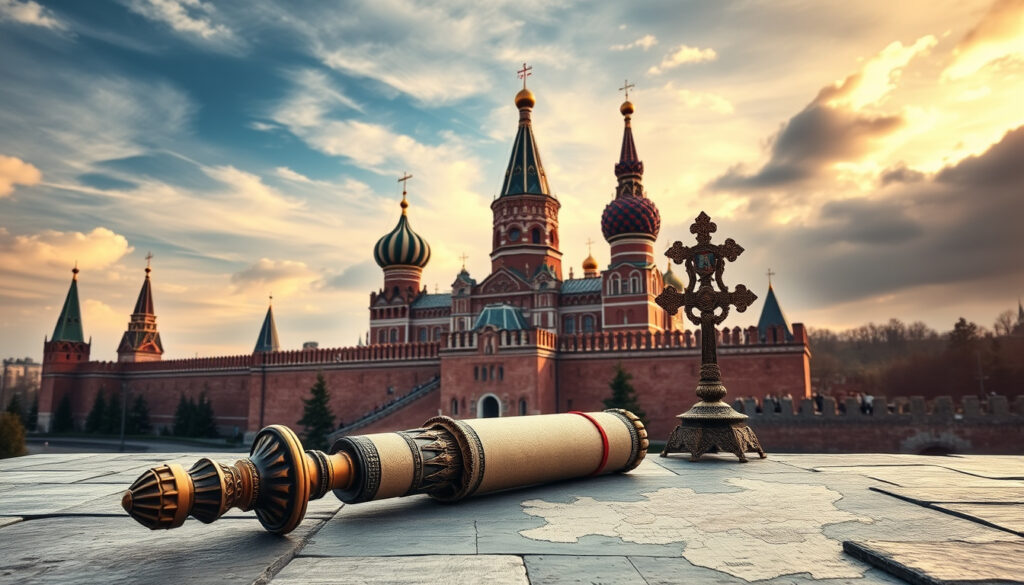
Ivan the Terrible: Russia’s First Tsar, Reforms & Legacy
Few figures in history stir as much fascination as Ivan IV of Russia—the tsar who unified a sprawling state while leaving a trail of bloodshed that still sparks debate. He was crowned the first Tsar of all Russia in 1547, ushering in a reign of 37 years that reshaped the country’s political structure, yet his methods of centralization included state terror that would define his reputation for centuries.
Born: 1530 ·
Crowned Tsar: 1547 ·
Reign ended: 1584 ·
Killed his son: 1581 ·
Known for: First Tsar of Russia, centralization, terror
Quick snapshot
- Ivan was the first Tsar of Russia, crowned in 1547 (HISTORY UK (history publisher))
- He established the Oprichnina terror apparatus (Britannica (encyclopedia))
- He killed his son Ivan Ivanovich in 1581 (Britannica (encyclopedia))
- The exact motive for killing his son remains debated (Britannica (encyclopedia))
- Severity of Ivan’s mental health condition is not fully known (Britannica (encyclopedia))
- Some accounts of his cruelty may be exaggerated by later sources (HISTORY UK (history publisher))
- 1530–1584: Ivan’s life spans Russia’s transformation (Britannica (encyclopedia))
- 1565–1572: Oprichnina period marks peak state terror (Britannica (encyclopedia))
- 1581: The killing of his son becomes a defining event (Britannica (encyclopedia))
- Historians continue to debate whether reforms outweighed repression (StudyCorgi (academic analysis))
- Ivan’s legacy influences modern Russian ideas of strong rule (StudyCorgi (academic analysis))
- The Rurik dynasty ended with his son Feodor I in 1598 (Britannica (encyclopedia))
Seven key facts about Ivan’s life and reign, one pattern: a ruler who concentrated authority so fiercely that his state and personal tragedies became inseparable.
Ivan’s personal history and his state-building efforts share a brutal symmetry that historians continue to dissect.
| Attribute | Detail |
|---|---|
| Full Name | Ivan Vasilyevich (Ivan IV) |
| Title | Tsar of all Russia |
| Born | August 25, 1530, Kolomenskoye |
| Died | March 28, 1584, Moscow (stroke) |
| Spouse | Anastasia Romanovna (first wife) |
| Children | Ivan Ivanovich (killed), Feodor I, others |
| Dynasty | Rurik |
Who Was Ivan the Terrible?
Early Life and Ascension
- Ivan IV was born in 1530 to Vasili III and Elena Glinskaya (HISTORY UK (history publisher))
- He became Grand Prince of Moscow in 1533 at age three after his father’s death (Britannica (encyclopedia))
- The boyars (nobles) fought for power during his childhood, shaping his worldview (Britannica (encyclopedia))
Ivan’s father Vasili III died in 1533, leaving the three-year-old Ivan as Grand Prince of Moscow. His mother Elena Glinskaya ruled as regent until her death in 1538, reportedly by poisoning. The boyar families—the Shuisky and Belsky factions—then tore at each other during Ivan’s minority, a period he later described as one of deprivation and fear. He wrote to Prince Kurbsky that the boyars “devoured one another like wild beasts” and treated him and his brother as outsiders.
Ivan’s childhood instability directly informed his later paranoia and his determination to crush the boyar class. The violence he witnessed as a child became the template for his rule.
First Tsar of Russia
- Crowned first Tsar of Russia in 1547 (Presidential Library of the Russian Federation (state library))
- The coronation was designed to emphasize the new political status of the ruler (Presidential Library of the Russian Federation (state library))
- The term “terrible” in Russian (Grozny) translates more accurately as “formidable” or “awe-inspiring” (HISTORY UK (history publisher))
On January 16, 1547, Ivan Vasilyevich was crowned Tsar of all Russia in the Assumption Cathedral of the Moscow Kremlin. The title “Tsar”—derived from Caesar—had been used unofficially before, but Ivan made it official and insisted on the imperial implication: direct authority from God, not from any earthly noble. The coronation ceremony included a blessing from Metropolitan Macarius, which Ivan understood as a divine mandate to rule absolutely.
What Did Ivan the Terrible Do?
Centralization of Power
- Ivan implemented legal and administrative reforms shortly after his coronation (EBSCO Research Starters (academic database))
- He brought local administration under stronger central control (Britannica (encyclopedia))
- His reforms ended local administration by rotating military governors (Britannica (encyclopedia))
- He limited monastic landholding and the juridical rights of landlords over peasants (Britannica (encyclopedia))
- Ivan is credited with creating the Zemsky Sobor, a national assembly, though historical consensus on this varies (Facebook group post (low confidence))
Within a decade of his coronation, Ivan launched a series of reforms collectively known as the “Reforms of the Chosen Council.” He introduced a new legal code (Sudebnik of 1550) that standardized justice across the realm. He created the Zemsky Sobor, a consultative assembly that included clergy, gentry, and townspeople—a proto-parliament that gave Ivan a veneer of popular legitimacy while concentrating power at the center. He also reorganized the military, reportedly establishing the first Russian standing army with the streltsy (musketeer) regiments.
These reforms did more than streamline governance. They transferred real power from the hereditary aristocracy to a service-based nobility loyal directly to the tsar, creating the institutional framework for Russian autocracy that lasted for centuries.
Military Campaigns and the Livonian War
- Ivan expanded Russia’s territory through campaigns against Kazan and Astrakhan (Britannica (encyclopedia))
- The Livonian War (1558–1583) drained state resources and weakened Russia (Britannica (encyclopedia))
- Ivan pursued an assertive trade relationship with England, establishing the Muscovy Company (Lumen Learning (educational publisher))
Ivan’s military campaigns gave him a mixed record. His forces conquered the Khanates of Kazan (1552) and Astrakhan (1556), opening the Volga trade route and securing Russia’s eastern frontier. But his 25-year Livonian War against the Polish–Lithuanian Commonwealth, Sweden, and Denmark was a strategic disaster that nearly bankrupted the state. By 1582, Russia had lost its Baltic foothold and was militarily exhausted.
The trade-off: territorial expansion in the east came at the cost of overextension in the west. Ivan’s inability to win decisively in Livonia fueled his suspicion that the boyars were betraying him, accelerating the descent into terror.
Establishment of the Oprichnina
- Created the Oprichnina as a state policy of terror (Britannica (encyclopedia))
- Ivan used terror as a tool to centralize the Russian state (Britannica (encyclopedia))
- The Oprichnina period (1565–1572) involved the execution and exile of boyars, confiscation of their estates, and the establishment of a separate territory directly ruled by Ivan (Britannica (encyclopedia))
In 1565, Ivan created the Oprichnina—a separate administrative territory and personal guard force of 1,000 men, later expanded to 6,000, known as the oprichniki. These men dressed in black and rode black horses, carrying a dog’s head and a broom as symbols of their mission: to sniff out traitors and sweep them away. Ivan split the Russian state in two: the Oprichnina lands under his direct control and the Zemshchina under the boyar council. Over seven years, the oprichniki executed thousands of boyars, church leaders, and peasants, confiscated their land, and resettled them en masse. The terror ultimately turned against itself when Ivan executed the Oprichnina’s own leaders, including Prince Vyazemsky, in 1570.
The Oprichnina was intended to eliminate threats to Ivan’s authority, but it destabilized the very state he was trying to centralize. It destroyed the old boyar class without creating a stable alternative, leaving a power vacuum that would trigger the Time of Troubles after Ivan’s death.
Was Ivan the Terrible a Good Leader?
Accomplishments and Reforms
- Historians debate his effectiveness (StudyCorgi (academic analysis))
- He improved state structure through legal and administrative reforms (Britannica (encyclopedia))
- He established Russia as a centralized monarchy with the tsar at its apex (Britannica (encyclopedia))
On the side of accomplishments, Ivan’s reforms were genuinely modernizing. He standardized law codification, established a printing press in Moscow (the first in Russia), expanded higher education, and created a postal service. He centralized tax collection and land administration. His conquest of Kazan and Astrakhan transformed Russia from a landlocked principality into a multi-ethnic empire spanning Europe and Asia. The Zemsky Sobor model would influence Russian governance for centuries, and the legal code he introduced remained in effect with revisions until the 17th century.
The pattern: Ivan built the bureaucratic skeleton that later tsars used to govern an empire, but institutional strength came at a human cost that his successors would inherit.
Reputation for Cruelty
- Ivan’s rule is commonly described as ruthless in popular biographies (Biography.com (biography publisher))
- He acquired vast amounts of land through ruthless means (Biography.com (biography publisher))
- The Oprichnina terror killed thousands, possibly tens of thousands, of his subjects (Britannica (encyclopedia))
But the cruelty is not in doubt. Ivan personally participated in torturing suspects. He had the Archbishop of Novgorod, Pimen, killed and thousands of Novgorod citizens drowned in the Volkhov River during a 1570 massacre. He executed entire boyar families and confiscated their estates. The English diplomat Giles Fletcher, who visited Russia in 1588, reported that Ivan had executed so many nobles that the tsar’s court was reduced “to great scarcity of wise men.” The monetary cost of the Livonian War plus the Oprichnina’s destruction of productive land contributed to a famine in the 1570s that killed tens of thousands of peasants.
Long-Term Impact on Russia
- His terror tactics caused lasting instability (Britannica (encyclopedia))
- Ivan’s legacy is described as a combination of centralizing reforms and oppressive policies (StudyCorgi (academic analysis))
- The Time of Troubles (1598–1613) followed the end of the Rurik dynasty after Ivan’s death (Britannica (encyclopedia))
The pattern is clear: Ivan’s legacy is a paradox wrapped in blood. He built the institutional skeleton of centralized Russian autocracy—the tsar as absolute ruler, the service gentry as the governing class, the state as owner of land and people. But the terror he unleashed as the cost of that centralization broke the economy, decimated the elite, and left a traumatized society. His son Feodor I (Feodor the Bellringer) was mentally and physically incapable of ruling alone, and when Feodor died without heir in 1598, the Rurik dynasty ended, plunging Russia into 15 years of civil war and foreign invasion known as the Time of Troubles.
Who Was Ivan the Terrible’s Son and Why Did He Kill Him?
Ivan Ivanovich
- Ivan’s son and heir was Ivan Ivanovich (born 1554) (Britannica (encyclopedia))
- He was about 27 years old at the time of his death in 1581 (Britannica (encyclopedia))
- He was married three times; his father had beaten his first wife to death for her inability to bear children (Britannica (encyclopedia))
Ivan Ivanovich was the tsar’s eldest surviving son and the designated successor. Contemporary accounts describe him as capable and popular with the military—precisely the qualities that may have triggered his father’s jealousy. He had participated in military campaigns in Livonia and had his own court circle, which included boyars who opposed the Oprichnina. The dynamic between father and son appears to have been tense in the years leading up to the fatal incident.
The Incident of 1581
- Ivan killed his son Ivan Ivanovich in 1581 (Britannica (encyclopedia))
- The motive is disputed (Britannica (encyclopedia))
- The event is immortalized in the famous painting by Ilya Repin, “Ivan the Terrible and His Son Ivan” (1885) (Britannica (encyclopedia))
The exact circumstances are known from a single contemporary account—the journal of the papal envoy Antonio Possevino, who was in Moscow at the time. According to Possevino, on November 16, 1581, Ivan had struck his pregnant daughter-in-law Helena in a rage because she was wearing “immodest” clothing. Ivan Ivanovich confronted his father about the assault. The Tsar flew into a fury and struck his son in the head with his staff—a blow that caused a fatal hemorrhage. The younger Ivan died four days later.
The implication: whether it was an accident or murder, the killing marked the definitive end of Ivan’s hopes for a stable succession. The heir he had groomed was dead by his own hand, leaving only Feodor, who was widely regarded as unfit to rule.
Historical Interpretations
- Some historians argue the killing was accidental during a heated argument (Britannica (encyclopedia))
- Others see it as the inevitable outcome of Ivan’s explosive temper and paranoia (Britannica (encyclopedia))
- Russian historian Nikolay Karamzin (in the 19th century) portrayed it as the culmination of Ivan’s moral decline (Britannica (encyclopedia))
The debate over motive is unresolved. Possevino’s account suggests anger over Helena’s clothing was the trigger—hardly a calculated political assassination. But the context matters: Ivan had killed before, and his paranoia in 1581 was at its peak. Earlier that year, he had uncovered a plot (real or imagined) among the Novgorod boyars. He had also recently executed his secretary, Ivan Viskovaty, for suspected treason. Ivan Ivanovich may have been seen as a potential rival or threat.
The Repin painting, which depicts a horrified Ivan cradling his dying son, has itself become a cultural artifact. It was banned from exhibition in 1913 after a man slashed it with a knife, and it remains a powerful symbol of how later generations processed Ivan’s tragedy—as a personal, not just political, catastrophe.
What Was Ivan the Terrible’s Childhood Like?
Orphaned Young
- His parents died when he was young (HISTORY UK (history publisher))
- His father Vasili III died in 1533 when Ivan was three (Britannica (encyclopedia))
- His mother Elena Glinskaya died in 1538, reportedly poisoned (Britannica (encyclopedia))
Ivan was an orphan by age eight. His mother’s death—almost certainly by poisoning at the hands of the Shuisky faction—left him alone among the boyars, who treated him alternately as a puppet and as an obstacle. The young Ivan later wrote that he and his younger brother Yuri were “deprived of all human necessities” and “treated like slaves.”
Struggle for Power Among Boyars
- He witnessed boyar violence during his formative years (Britannica (encyclopedia))
- The Shuisky and Belsky families fought for control of the regency, killing each other’s members in brutal feuds (Britannica (encyclopedia))
- Ivan was forced to preside over executions of boyars he barely knew, decisions made by adults, not himself (Britannica (encyclopedia))
Between 1538 and 1543, the boyar factions conducted a violent mini-war for control of the regency. The Shuiskys murdered the Belsky leader, Ivan Belsky, and threw him onto a garbage heap. They imprisoned Ivan’s tutor, Metropolitan Daniel. The young tsar watched men he had trusted beaten and killed in front of him. In 1543, at age 13, Ivan ordered the execution of Prince Andrey Shuisky—his first independent act of violence, having been convinced that Shuisky was plotting against him. The boyars were reportedly thrown to Ivan’s hunting dogs.
Formative Experiences
- This influenced his later paranoia and suspicion of the nobility (Britannica (encyclopedia))
- Ivan developed a deep belief that only absolute authority could prevent chaos (Britannica (encyclopedia))
- His childhood experiences shaped the Oprichnina’s targeting of boyar families (Britannica (encyclopedia))
Timeline of Ivan’s Life and Reign
Ivan born to Vasili III and Elena Glinskaya (Britannica (encyclopedia)).
Vasili III dies; Ivan becomes grand prince at age 3 (Britannica (encyclopedia)).
Ivan crowned first Tsar of Russia (Presidential Library of the Russian Federation (state library)).
Military reforms and expansion of Russia; first campaigns against Kazan and Astrakhan (Britannica (encyclopedia)).
Death of wife Anastasia; Ivan’s mental state deteriorates (Britannica (encyclopedia)).
Oprichnina period; state terror against boyars (Britannica (encyclopedia)).
Ivan kills his son Ivan Ivanovich during a quarrel (Britannica (encyclopedia)).
Ivan dies; is succeeded by son Feodor I (Britannica (encyclopedia)).
britannica.com, en.wikipedia.org, historyhit.com, youtube.com
Historians continue to debate the full extent of Ivan the Terrible’s reign, as detailed in Ivan the Terribles reign.
Frequently asked questions
Why was Ivan called “the Terrible”?
The Russian word Grozny translates more accurately as “formidable” or “awe-inspiring” rather than “terrible” in the modern sense. Western translations of historical accounts used “Terrible” to emphasize his cruelty, but Ivan himself intended the title to convey his power and divine authority as tsar (HISTORY UK (history publisher)).
Did Ivan the Terrible marry more than once?
Yes. Ivan married at least seven times, though church law allowed only three marriages. Anastasia Romanovna was his first wife (married 1547, died 1560); her death deeply affected him. Later wives included Maria Temryukovna, Marfa Sobakina (who died shortly after marriage), Anna Koltovskaya (exiled to a convent), and others. Some sources suggest there were additional, unacknowledged marriages (Britannica (encyclopedia)).
What happened to Ivan’s first wife?
Anastasia Romanovna died in 1560, probably from poisoning or illness. Ivan was devastated and became increasingly paranoid afterward, believing boyars had poisoned her. Her death is considered a turning point in his reign, after which the violence and instability accelerated (Britannica (encyclopedia)).
Was Ivan the Terrible popular among common people?
Evidence is mixed. Some chronicles suggest peasants saw Ivan as a defender against the boyars’ oppressive power—a common narrative of the “good tsar” betrayed by evil nobles. But the Oprichnina terror extended to villages, and the economic devastation of the Livonian War and Oprichnina caused famines that killed tens of thousands of peasants. Likely, opinion was divided: hope among those not directly affected, and terror among those who were (Britannica (encyclopedia)).
How did Ivan the Terrible die?
Ivan died on March 28, 1584, in Moscow, reportedly of a stroke while playing chess. The exact cause is uncertain, but it came at the end of a period of declining health marked by intense pain and mental instability. Some historians have speculated that he may have been poisoned, but there is no conclusive evidence (Britannica (encyclopedia)).
What is the Oprichnina?
The Oprichnina was a state policy (1565–1572) under which Ivan established a separate territory and a personal guard force of oprichniki. It involved mass executions, confiscation of lands, and forced resettlements targeting the boyar nobility. Its purpose was to eliminate all perceived opposition and centralize power under the tsar. It effectively created a dual state within Russia until Ivan disbanded it in 1572 (Britannica (encyclopedia)).
Did Ivan the Terrible end the Rurik dynasty?
Indirectly, yes. Ivan’s son Feodor I succeeded him but died childless in 1598, ending the Rurik dynasty’s direct male line. Ivan had killed his other son Ivan Ivanovich in 1581, leaving no viable heir. Feodor’s death triggered the Time of Troubles (1598–1613), a period of dynastic crisis, civil war, and foreign invasion that ended only with the election of Michael Romanov as tsar (Britannica (encyclopedia)).
For anyone reading Russian history today, the choice is clear: you can see Ivan as the architect of Russian autocracy who built a nation-state out of competing factions, or as the tyrant whose methods destroyed the stability he sought to create. Both views are supported by the evidence. What matters is recognizing that the two are inseparable—the reforms and the terror came from the same man, the same beliefs, and the same formative wounds.
More related posts
 Belle Burden: Memoir, Ex-Husband & Vanderbilt Ties
 Ashes 5th Test – England’s 49-Run Win Levels Series
 Abraham Lincoln: Life, Death, and 17 Burials
 Leicester City Games – 2024/25 Premier League Fixtures
 Elijah Hollands Incident Leads to $75,000 AFL Fine
 Ji Hyo: Song Ji-hyo vs TWICE Jihyo – Complete Comparison
 Lincoln Lewis: Home and Away Actor, Getaway Presenter, Career Update
 Timothy Simons: Biography, Height, Family, and Career
