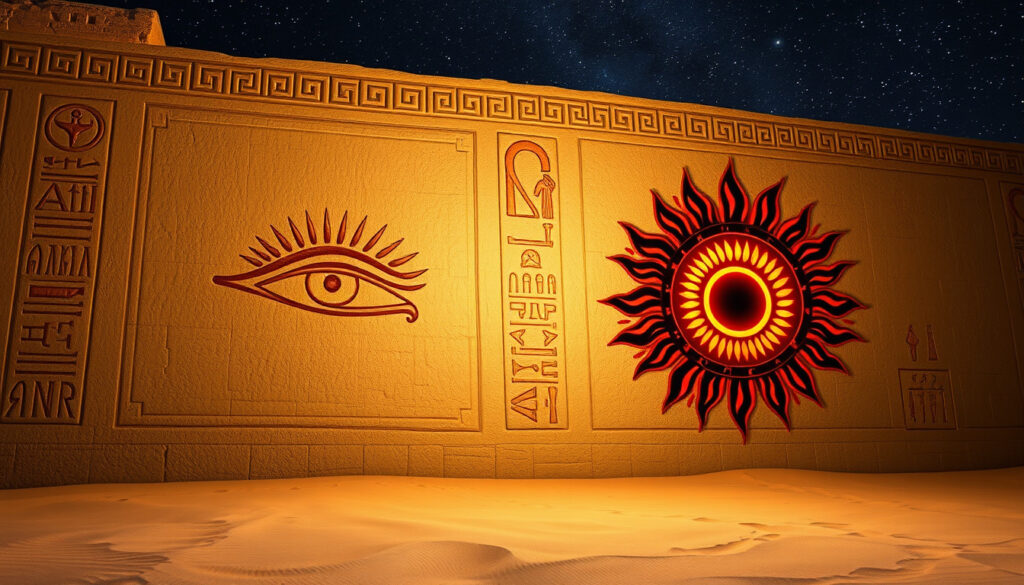
Eye of Horus: Symbol Meaning, Myth & Eye of Ra Difference
Walk through any museum of Egyptian antiquities and you will spot it: that stylized falcon eye with the telltale swirl marking. The Eye of Horus was never decorative in the way modern jewelry might be. Ancient Egyptians wore it, painted it on coffins, and carved it into temple walls because they believed it held actual protective power. What that power meant, how it differs from the Eye of Ra, and whether you should wear one today are exactly the questions this article untangles.
Origin: Ancient Egypt · Primary Meaning: Protection and restoration · Mythical Battle: Horus vs. Set · Mathematical Use: Binary fractions 1/2 to 1/64 · Common Modern Use: Tattoos and jewelry
Quick snapshot
- The Eye of Horus was a protective symbol in ancient Egypt, used on boats, coffins, and jewelry (Egypt Time Travel)
- Horus lost his eye fighting Set and had it restored by Thoth (Study.com)
- Eye of Horus amulets span from the Old Kingdom (2686–2181 BC) to the Roman period (Egypt Tours Portal)
- Scholars reportedly disagree on exact origins of the symbol’s specific design elements (Egypt Tours Portal)
- Some versions of the Horus-Set mythology contain intimate content, details of which vary across sources (Study.com)
- Old Kingdom (2686–2181 BC): Eye of Horus amulets become common (Egypt Tours Portal)
- New Kingdom (1570–1050 BC): Sun/moon associations between the two eyes become clearer (Egypt Tours Portal)
- The Eye of Horus remains popular in modern jewelry and tattoo culture, though cultural and religious debates about wearing it persist
- Understanding the distinction between Eye of Horus and Eye of Ra helps frame why one became associated with healing and the other with power
| Attribute | Value |
|---|---|
| Associated Deity | Horus |
| Primary Symbolism | Protection, health |
| Myth Event | Battle with Set |
| Alternative Name | Wedjat |
| Usage Period | Old Kingdom to Roman (2686 BC – 641 AD) |
| Eye Side | Left eye (moon) |
What Does the Eye of Horus Symbolize?
The Eye of Horus stands for protection, healing, restoration, and royal power. Egyptians linked it to the sky god Horus and to the moon itself (Egypt Time Travel). The symbol shows a stylized falcon eye, and its markings are not arbitrary — they encode a story about what happens when order is broken and then made whole again.
Protection and Power
Ancient Egyptians placed Eye of Horus amulets on boats, coffins, and jewelry specifically to ward off evil and protect the wearer (Egypt Time Travel). The symbol appears in temples like Edfu and Karnak, where it served as a marker of watchful divine presence. Unlike the Eye of Ra, which protects through power and control, the Eye of Horus protects by repairing and restoring (The Art Newbie).
Healing and Restoration
The myth goes like this: Horus, avenging his father Osiris, fought Set and lost his eye in the battle. The god Thoth restored it. That act of restoration gave the symbol its association with health and wholeness (Study.com). Egyptians placed Eye of Horus symbols on the chest and in burial wrappings precisely because they believed the mark kept the body whole in the afterlife.
Mathematical Significance
The distinct markings of the Eye of Horus correspond to fractions — 1/2, 1/4, 1/8, 1/16, 1/32, and 1/64. These reportedly related to ancient Egyptian measurements for medicine and grain, tying the symbol to practical healing applications (The Art Newbie). The connection between mythology and mathematics was not coincidental: the restoration of Horus’s eye was understood as restoring complete order, and order in Egyptian thought encompassed numbers and proportions.
What Does 𓂀 Mean?
The hieroglyph 𓂀 is the Eye of Horus in its written form. It reads as a visual sentence: an eye, an eyebrow, the spiral marking below, and the cheek flick that represents restoration. Each component has a name and a value, but together they tell one story about a god who was injured and healed.
Symbol Breakdown
Egyptologists break the Eye of Horus into six parts, each associated with a fraction. The eyebrow represents 1/8, the pupil 1/4, the left side spiral 1/2, the right feather 1/16, the tail feather 1/32, and the missing cheek piece 1/64 (Egypt Time Travel). The six parts add up to a complete eye — and that completeness was the point.
Mythical Origins
Ancient texts describe Horus offering his eye to Set as a gesture of peace — an act that became the mythological basis for the symbol’s protective meaning (Study.com). The moon association developed later: the eye’s phases were read as a reflection of Horus’s own cycle of loss and renewal, tying the symbol to lunar timekeeping (Derek Dodds).
Eye of Ra vs. Eye of Horus: Understanding the Difference
Two eyes dominate Egyptian iconography, and mixing them up misses the point of both. The Eye of Horus and the Eye of Ra serve different mythological functions, carry different emotional registers, and appear in different contexts. A quick side-by-side comparison shows why the distinction matters.
| Attribute | Eye of Horus | Eye of Ra |
|---|---|---|
| Deity | Horus | Ra |
| Eye side | Left (moon) | Right (sun) |
| Form | Stylized falcon eye | Human eye with sun motifs |
| Primary meaning | Healing and restoration | Power, retribution, wrath |
| Method of protection | Repair (inward) | Punishment (outward) |
| Personified as | Wadjet, Nekhbet | Sekhmet, Hathor |
| Tomb appearance | Funerary contexts, coffins | Tombs of Seti I, Ramesses VI |
Key Distinctions
Unlike the Eye of Horus, which represents healing and restoration, the Eye of Ra meaning is deeply tied to power, protection, and retribution (Egypt Time Travel). The Eye of Ra acts as an extension of the sun god’s will — sent out to punish enemies, then returning to its owner. The Eye of Horus, by contrast, works by repairing damage and restoring wholeness from within.
Shared Traits
Both eyes appear on tomb walls, both serve protective functions, and both are tied to cosmic order. The Eye of Ra is linked to Ma’at — the concept of cosmic balance that the sun god upholds as an active enforcer (Egypt Time Travel). The Eye of Horus, meanwhile, restores Ma’at after it has been broken. In practice, Egyptians used both symbols together, recognizing that protection required both vigilance and repair.
The Eye of Ra is what you call on when threats come from outside. The Eye of Horus is what you need when damage has already been done. Understanding which eye serves which function explains why tomb painters used both, not either-or.
Is the Horus Eye Good or Bad?
No inherent evil attaches to the Eye of Horus. The symbol carries an overwhelmingly positive charge in its original context — it is about healing, protection, and the restoration of order (Study.com). The confusion that sometimes arises comes from people conflating it with the Eye of Ra, which does carry associations with divine wrath and punishment.
Mythical Context
In the Osiris-Set myth, Horus fights to avenge his father and reclaim what is rightfully his. His injury — the loss of his eye — is not a moral failing but a wound sustained in a just cause. The healing of that eye by Thoth is understood as divine intervention, making the restored symbol a sign of divine favor, not malevolence.
Modern Interpretations
Contemporary usage in jewelry and tattoos generally frames the Eye of Horus as a protective amulet, drawing on its ancient meaning (Faith Heart Jewelry). The symbol does not carry the association with the “evil eye” that some Mediterranean and Middle Eastern cultures assign to protective symbols more broadly. It is not a curse or a threat — it is a promise of repair.
Anyone considering a tattoo or piece of jewelry with the Eye of Horus should understand that in its original form, the symbol carries only protective and healing meaning. The association with darkness or malevolence is a modern misunderstanding, not a historical fact.
Is It Okay to Wear the Eye of Horus?
Wearing the Eye of Horus as a necklace, ring, or tattoo is common and generally socially acceptable. The symbol has appeared on jewelry for thousands of years, from amulets of the Old Kingdom (2686–2181 BC) to contemporary designer pieces. But cultural and religious sensitivity varies, and the question deserves a fuller answer than a simple yes or no.
Cultural Considerations
The Eye of Horus appears widely in pop culture, fashion, and new-age spirituality, often divorced from its Egyptian origins. Most people wearing an Eye of Horus pendant or displaying it as body art are drawing on its meaning of protection and are not making any religious claim. Egyptian revival jewelry is a legitimate commercial and cultural category, and buyers participate in a tradition that dates back millennia (Egypt Tours Portal).
Religious Views
Some Islamic scholars reportedly consider the Eye of Horus — along with other eye-shaped protective symbols — problematic because of associations with magic, shirk (associating partners with God), or pre-Islamic Egyptian religion. The debate is ongoing, and rulings vary by scholar and tradition. Individuals who hold these concerns typically advise against wearing the symbol as an amulet with protective intent. For those without these specific religious reservations, the Eye of Horus functions as any other cultural symbol — aesthetically significant, historically rooted, and open to personal interpretation.
Upsides
- Ancient tradition of protective use with documented history
- Wide availability in jewelry and tattoo culture
- Positive associations with healing, health, and protection
- No inherent religious commitment required to wear it
Downsides
- Some Islamic scholars advise against it due to magical associations
- Can be perceived as cultural appropriation if worn without understanding
- Confusion with Eye of Ra may draw wrong assumptions
- Modern fashion usage has diluted original sacred meaning for some
The legend behind the Eye of Horus is one of regeneration and healing, promoting a more positive symbolism that promises divine intervention and protection from the gods.
— Study.com (Educational Platform)
Eye of Horus protects by repairing. As an amulet on the chest, in the wrappings, or painted on coffins, it keeps the body whole.
— The Art Newbie (Art Blog)
Related reading: Someone You Loved meaning
Just as the Eye of Horus symbolizes protection and restoration in Egyptian lore, the evil eye necklace history has shielded wearers from malevolent forces since Mesopotamian times.
Frequently asked questions
Who was Seth’s wife?
Set’s wife was Nephthys, a goddess who played a complex role in the mythology surrounding Osiris, Set, and Horus. Nephthys is often depicted alongside Set and is associated with death, mourning, and the boundary between life and the afterlife.
Did Seth get pregnant by Horus?
This question refers to a specific and unusual episode in the Horus-Set myth cycle, where the two gods compete for the throne of Osiris. According to some versions, Set attempted to impregnate Horus (or vice versa in other retellings) as part of their contest. Scholars note that multiple versions of the legend exist and that details vary significantly across sources.
What is the Celtic Eye of Horus?
The Celtic Eye of Horus is not a historically documented Celtic symbol. Some modern occult and esoteric traditions have adapted Egyptian symbolism and combined it with Celtic imagery, but this represents a contemporary syncretism rather than a documented ancient practice. Those encountering the term should verify the specific source claiming the connection.
Can Muslims wear the Eye of Horus?
Views vary among Islamic scholars. Some reportedly advise against wearing it due to associations with magic or pre-Islamic religious practice. Others treat it as a purely aesthetic cultural symbol with no inherent spiritual claim. Individuals with personal religious convictions should consult a trusted scholar or authority within their tradition.
How did Egyptians view homosexuality?
Ancient Egyptian attitudes toward same-sex relationships appear to have been more nuanced than often assumed. While the Horus-Set myth contains an intimate episode between the two gods, interpreting this as a statement about homosexuality is complicated by the mythic context. Ancient sources do not present a unified or clearly documented stance on the matter, and scholars continue to debate the evidence.
What is Eye of Horus M4A4?
This appears to be a reference to a CS:GO (Counter-Strike: Global Offensive) weapon skin called “Eye of Horus” in the M4A4 configuration. The name borrows the Egyptian symbol for aesthetic purposes but carries no historical or religious significance in this gaming context.
What is Eye of Horus 40k?
In Warhammer 40,000 lore, Horus is a central character whose name draws on the Egyptian god but whose story is entirely fictional. The “Eye of Horus” in this context refers to a symbol associated with the character Horus Lupercal and the Space Marine legions aligned with him. This is separate from the Egyptian symbol entirely.
Does the evil eye protect you?
The “evil eye” (known as nazar in Turkish and similar terms across Mediterranean and Middle Eastern cultures) is a protective charm meant to deflect malevolent glances. It functions as a protective symbol but is conceptually distinct from the Eye of Horus. The evil eye protects by deflecting harm; the Eye of Horus protects by restoring what has been damaged.
The Eye of Horus endures because it answered a need that did not disappear with the pharaohs — the need to believe that broken things can be repaired. For ancient Egyptians, that meant physical wholeness in life and the afterlife. For modern wearers, it often means something vaguer but no less powerful: a token that stands for the idea that protection is possible, that restoration is real. Whether you come to it as a student of mythology, a seeker of symbolic jewelry, or someone drawn to the specific story of a god who lost everything and got it back, the Eye of Horus offers a design that has proven durable across three thousand years of human use.
More related posts
 Timothy Simons: Biography, Height, Family, and Career
 Cameron Ciraldo: Bio, Salary, Record & Latest News
 Chris Dawson: The Murderer, His Wife, and Billionaire Confusion
 Acid Reflux Symptoms: Worst Signs, Causes & Relief Tips
 Kia Carnival 2026: Pricing, Seating & Common Issues
 Shark Tank: Concept, Cast, and Top Deals Explained
 Indie Bostock: Age, Career, Siblings & Dragons Exit
 Kimbo Slice: Death, UFC Record, and Lasting Legacy
