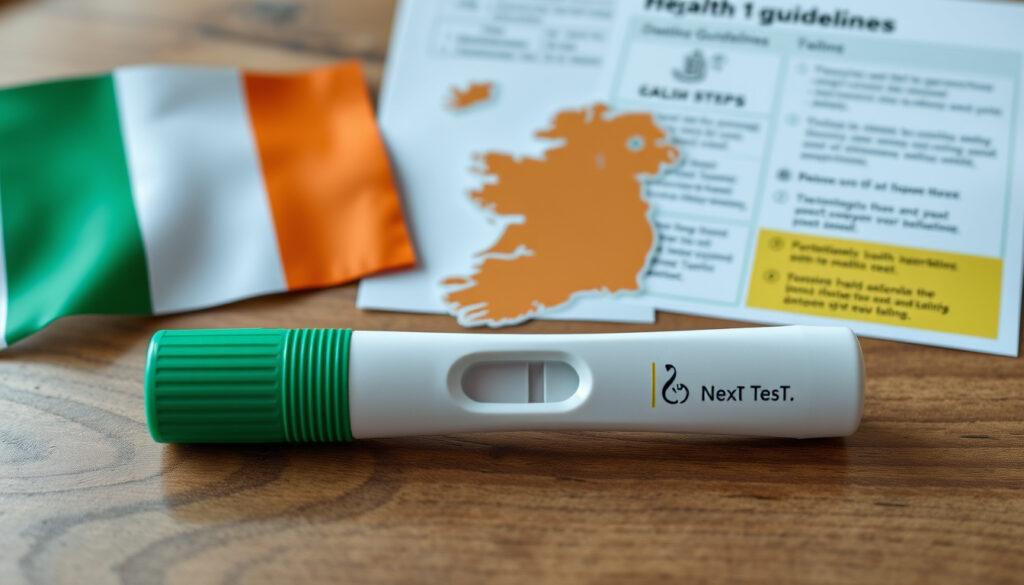
Positive COVID Test: What It Means and Next Steps in Ireland
If a faint line on a COVID test still counts as positive, and you’re on the clock with work or family obligations, the rules matter more than ever. Ireland’s Health Service Executive (HSE) has specific guidance on what happens after a positive antigen test—and it differs in important ways from the rest of the UK. This guide walks through how to read your test, what isolation actually means in Ireland, and when it’s safe to head back into the world.
Isolation period (Ireland): 5 days ·
Typical contagious window: Up to 10 days ·
Positive test indicator: T line appears ·
Faint line validity: Still positive ·
Return to work (Ireland): After 5 days if symptoms improve
Quick snapshot
- Exact end date without negative test
- Current 2026 Ireland guidance status
- PCR confirmation requirements
- Monitor symptoms at home (HSE.ie)
- Notify close contacts (HSE.ie)
- Optional: retest before ending isolation (Lung.org)
The table below shows how Ireland’s COVID isolation rules compare with Northern Ireland and England/Wales.
| Detail | Ireland (HSE) | Northern Ireland (HSCNI) | England/Wales (NHS) |
|---|---|---|---|
| Standard isolation | 5 days | 10 days | 5 days (adults) |
| Child isolation | Varies | Varies | 3 days |
| High-risk avoidance | 10 days | 10 days | 10 days |
| Early release option | None specified | Day 6 with 2 neg LFDs | None |
Which line on a COVID test is positive?
Most rapid antigen tests have two zones: the Control (C) line and the Test (T) line. The C line simply confirms the test worked correctly—a missing C line means the test failed and should be repeated. The T line is where the result appears.
T vs C line explanation
A positive result shows two lines: one at C and one at T. The UK Department of Health and Social Care’s official instructions state: “If you have 1 line by C, and 1 line by T this is called a positive result. The lines can be bright or faint. You have COVID-19” (GOV.UK).
How to read antigen test results
The T line appears only if the SARS-CoV-2 nucleocapsid protein is detected at sufficient levels. There is no minimum brightness threshold—the test is engineered to return a positive for any detectable viral load above its sensitivity limit. This means the visual intensity of the T line varies widely between individuals and across the course of infection.
You should treat a faint line as a genuine positive result, not a borderline finding. The line intensity tells you about viral load—it does not indicate you’re safe to skip isolation. Even a barely perceptible T line means you should follow isolation guidelines.
Is a faint line still positive?
Yes. A faint T line means a positive result, and you should follow isolation guidelines as if the line were dark. This is one of the most common points of confusion with rapid antigen testing.
Faint T line meaning
“A faint line is a positive test result,” confirmed Dr. Amesh Adalja, an infectious disease specialist at Johns Hopkins University (UNMC Health Security). Dr. Thomas Russo, chief of infectious diseases at the University at Buffalo, put it more bluntly: “A faint line means you’re almost certainly positive” (UNMC Health Security).
The faintness reflects viral load levels—it can indicate early-stage infection when antigen levels are still building, or later-stage recovery when they are declining. Either way, the presence of any line meets the threshold the test was designed to detect.
Common test kit behaviors
Rapid antigen tests are calibrated for specificity. They are less likely to produce a false positive than a false negative, meaning if the T line appears, the test has high confidence that SARS-CoV-2 antigen is present. The line intensity does not correspond to a precise viral load count—rapid tests are qualitative, not quantitative.
“If you have 1 line by C, and 1 line by T this is called a positive result. The lines can be bright or faint. You have COVID-19.”
— UK Department of Health and Social Care, official self-test instructions
How long are you contagious after being positive for COVID?
Most people with COVID-19 are contagious for roughly 4–8 days after symptoms begin, though this varies with the variant and individual factors (Gavi, the Vaccine Alliance). With the Omicron variant and its sub-lineages, contagiousness may extend beyond this window.
Contagious period duration
After Ireland’s mandatory 5-day isolation ends, you may still be capable of transmitting the virus. The HSE advises avoiding contact with high-risk individuals for up to 10 days from symptom onset or the positive test date (HSE.ie). A faint line on day 8 or 9 of illness still warrants caution—even if you feel fine, assume some degree of infectiousness remains.
Factors affecting contagiousness
Viral load peaks around days 1–3 of symptoms for most adults but can persist longer in older adults, immunocompromised individuals, and those with severe illness. Vaccination reduces but does not eliminate transmission risk. The American Lung Association recommends retesting before ending isolation if possible, especially when returning to work or contact with vulnerable people (Lung.org).
Ireland’s 5-day isolation aligns with the contagious window for most people, but it’s a minimum, not a guarantee of non-infectiousness. The 10-day high-risk avoidance period is the more conservative guardrail.
The implication: If you interact with elderly colleagues, immunocompromised patients, or pregnant people, extending your self-imposed distancing and masking for the full 10 days reduces transmission risk even after the official isolation period ends.
Do you still have to isolate with COVID in Ireland?
Yes. A positive antigen test in Ireland triggers mandatory self-isolation. The requirement is straightforward: stay home and avoid contact with others from the date you test positive or develop symptoms (HSE.ie).
Current HSE guidelines
The HSE guidance for adults states you should self-isolate for 5 days from the date of your positive test or symptom onset, provided your symptoms are fully or mostly resolved for 48 hours before leaving isolation (HSE.ie). This applies whether you took a PCR test or an antigen rapid test.
For asymptomatic individuals who test positive, the isolation period runs 5 days from the test date itself. Even without symptoms, you are considered capable of transmitting the virus and must restrict movement.
Isolation duration and rules
Ireland’s rules differ meaningfully from Northern Ireland, where isolation lasts 10 days by default (HSCNI.net). Northern Ireland does offer an early exit path: if you test negative on two lateral flow tests taken 24 hours apart from day 5 onward, you may leave isolation from day 6. Ireland has no equivalent provision.
The HSE notes that a mild cough or loss of smell and taste can persist after the 5-day isolation ends—and this is acceptable. As long as you have been fever-free for 48 hours and your acute symptoms are improving, leaving home is permitted.
“Stay at home for 5 days from the date of your positive test or when your symptoms started. Leave isolation after 5 days if your symptoms have mostly or fully resolved for 48 hours.”
— Ireland Health Service Executive, official isolation guidance
When can I return to work after a positive COVID test Ireland?
In Ireland, you can return to work after completing the 5-day isolation period—provided your acute symptoms are improving and you have been fever-free for 24 hours without the use of fever-reducing medication (HSE.ie). There is no requirement for a negative test to return to work under current guidance.
Work return criteria
The practical checklist for returning to work in Ireland:
- At least 5 days have passed since your positive test or symptom onset
- No fever for 24 hours without medication
- Symptoms (if any) are improving—mild residual cough or loss of taste/smell does not prevent return
- You can wear a mask for a few days when in close contact with others, especially high-risk colleagues
If your workplace has its own protocols, follow the more restrictive guidance. Some employers may still require a negative test or a longer self-exclusion period.
Reporting positive result
Ireland does not mandate reporting a positive rapid antigen test to a central database for most citizens, though this may vary by employer or healthcare setting. The HSE encourages notifying close contacts so they can monitor for symptoms and test if appropriate (HSE.ie).
Even after the 5-day isolation ends, the HSE recommends limiting contact with high-risk individuals for up to 10 days. If you work near elderly colleagues, immunocompromised patients, or pregnant people, consider extending your self-imposed distancing and masking for the full 10-day window.
The implication: Employers asking staff back on day 5 are following the minimum HSE requirement. Workers returning to close-contact settings should negotiate additional precautions if the 10-day high-risk window is still open.
How to test yourself for COVID-19
Most rapid antigen test kits include a swab, a cartridge, and a buffer solution. The process takes 10–15 minutes. Follow the instructions in your specific kit exactly—variations in swab type (nose-only vs. nose and throat) and swabbing technique affect accuracy.
- Wash your hands before opening the test kit
- Insert the swab into your nostril (or throat, depending on kit) as instructed
- Rotate the swab firmly against the nasal wall or rub the tonsil area
- Place the swab into the buffer solution and mix as directed
- Drop the specified number of drops into the cartridge well
- Wait the stated time (usually 10–15 minutes) before reading the result
- Read the result within the window specified—results outside the window may be unreliable
For additional guidance on using antigen tests, the HSE provides detailed instructions at HSE.ie. Free antigen tests may be available through HSE distribution points or participating pharmacies—check with your local HSE centre for current availability.
The implication: Skipping steps or reading results outside the window reduces test reliability. Following kit instructions precisely maximizes the chance of an accurate result.
What are the signs you’re no longer contagious?
The most reliable sign that you are no longer contagious is a combination of clinical and laboratory criteria: at least 5 days from symptom onset, no fever for 24 hours without medication, and improving acute symptoms (HSE.ie). Some health authorities suggest a negative rapid test provides additional reassurance, but Ireland’s guidance does not require it.
If you have access to rapid tests, taking one around day 7–10 can help confirm declining antigen levels. A strongly positive test at day 10 suggests ongoing infectiousness, even if you feel well. Science News notes that a faint positive line on day 12 still means you should assume some level of contagiousness (Science News).
Feeling better does not equal non-infectious. The fever-free and symptom-clearing milestones matter most. Residual effects like a lingering cough can last weeks after you’ve stopped being contagious.
The pattern: Ireland’s guidance emphasizes symptom resolution over test-based clearance. Workers should not use a positive rapid test on day 6 or 7 to justify early return if acute symptoms persist.
Are HSE antigen tests free?
The Irish government distributed free antigen tests widely during earlier phases of the pandemic. The last official update on antigen test distribution from Gov.ie was 8 March 2022 (Gov.ie), though distribution programmes have been scaled back significantly.
Current availability varies by region and healthcare setting. Pharmacies sell rapid antigen test kits if you need to purchase one. If you have a medical card or are eligible for other HSE supports, check with your GP or local health centre for free or subsidised test access.
What this means: Free antigen test distribution in Ireland has been wound down since 2022. Anyone needing tests now should check with local pharmacies or HSE outlets for current availability.
How to interpret COVID-19 Antigen Rapid Test Results
Interpreting a rapid antigen test result follows a simple binary logic:
- Positive: Two lines appear—one at C (control) and one at T (test). Even a faint T line is positive.
- Negative: Only the C line appears. No T line means no detectable antigen.
- Invalid: The C line does not appear. The test failed. Repeat with a new kit.
A negative result does not definitively rule out COVID-19. If you have symptoms or known exposure, testing again 24–48 hours later increases accuracy. Serial testing (testing on two consecutive days) is more sensitive than a single test for identifying infection.
What the evidence confirms
- 5-day isolation applies in Ireland (HSE)
- Any visible T line is positive (UNMC, GOV.UK)
- C line validates the test worked (GOV.UK)
- Fever-free 48h required before leaving isolation (HSE)
- Avoid high-risk contacts for 10 days (HSE)
What remains uncertain
- Precise contagious end date without a negative test
- Whether Ireland has updated guidance beyond 2022 sources
- Free test distribution current status
The implication: Rapid antigen tests are reliable when positive but can miss early infection. A single negative result after exposure or with symptoms warrants repeat testing before assuming you’re in the clear.
What to do if positive for work
Notify your employer as soon as you receive a positive result. You are entitled to paid sick leave or self-certification for the isolation period. Your employer cannot require you to return before the isolation criteria are met.
Keep a record of your test date and any communications with your employer regarding your return. If your workplace has a occupational health team or specific COVID return-to-work protocol, follow those instructions—they may be more protective than the minimum HSE requirements.
What this means: Employees in Ireland have legal protection against premature recall. Document your test date and symptom timeline to support any disputes about fitness to return.
How long do you test positive for COVID?
Rapid antigen tests can remain positive for 7–12 days after symptom onset in most adults, even as symptoms improve and fever resolves. This does not necessarily mean you are still contagious—viral debris can be detected after active replication has declined.
PCR tests are more sensitive and can remain positive for weeks after recovery, long after someone has stopped being infectious. This is why public health authorities have largely moved away from PCR-based return-to-work criteria for mild cases.
The pattern: A positive rapid test after you’ve recovered does not mean you’re still infectious. Viral debris persists even when active replication has ended, which is why symptom-based clearance works for most adults.
What does a positive COVID test look like?
On a standard rapid antigen test cartridge, a positive result displays as two distinct lines in the result window: the C line on the left and the T line on the right. Both lines may be equally dark, or the T line may be noticeably lighter than the C line. The image contrast on packaging illustrations often shows a darker T line than many people see in real tests—that does not make the result less valid.
The test window has a time limit—typically 10 to 30 minutes after applying the sample. Lines that appear after this window should not be interpreted, as the chemical reaction may produce false artifacts.
The gap between Ireland and Northern Ireland’s isolation rules (5 days vs. 10 days) reflects different policy choices, not different science. Both aim to balance preventing transmission with the practicalities of work and daily life. The safest personal approach treats the 10-day high-risk avoidance as the real end date—even if your employer is asking you back on day 5.
Frequently asked questions
How to test yourself for COVID-19?
Wash your hands, open the test kit, collect the sample as directed (nose or nose/throat depending on kit), mix the swab with the buffer solution, apply drops to the cartridge well, and wait 10–15 minutes before reading. Follow your specific kit’s instructions for accurate results.
What are the signs you’re no longer contagious?
The strongest signals are: no fever for 24 hours without medication, significant improvement in acute symptoms, and at least 5 days past symptom onset or the positive test date. If possible, a negative rapid test adds confidence, though Ireland does not require it.
Are HSE antigen tests free?
Free antigen test distribution has been scaled back since 2022. Check with your GP, local pharmacy, or HSE centre for current availability. Purchased tests are widely available at pharmacies if needed.
How to interpret COVID-19 Antigen Rapid Test Results?
Two lines (C + T) = positive, even if faint. One line (C only) = negative. No C line = invalid, repeat the test. Read results within the specified time window on your kit.
What to do if positive for work?
Notify your employer, complete 5-day isolation, ensure fever-free status for 24 hours and symptom improvement before returning. Keep records of your test date and return-to-work communications.
How long do you test positive for COVID?
Rapid antigen tests can stay positive for 7–12 days after symptoms begin, even after you feel well and are no longer contagious. PCR tests can remain positive even longer and are not reliable indicators of infectiousness.
What does a positive COVID test look like?
Two lines appear in the result window: the C (control) line and the T (test) line. Both may be equally dark, or the T line may be noticeably lighter. Any visible T line counts as positive, regardless of intensity.
Related reading: COVID Test Near Me in Ireland · Department of Education Ireland Addresses
HSE guidance following a positive COVID test in Ireland stresses isolating for at least five days, as clarified in the new isolation rules update.
More related posts
 Scarlet Vas: Marriage, Career, Age, and Controversy
 Danny Go: Real Name, Son’s Death, Net Worth, and Show Facts
 Toyota Finance Login: Access Your Account & Manage Payments
 ABC News Australia: Trusted News & Public Broadcasting Guide
 Josh Papalii: Injury, Contract & Career Update
 Food Delivery Apps vs. Meal Kits: 2026 Cost Comparison
 George VI: Biography, Cause of Death, and Why He Was Famous
 Australia Heatwave 40C Forecast: January 2026 Temperatures
