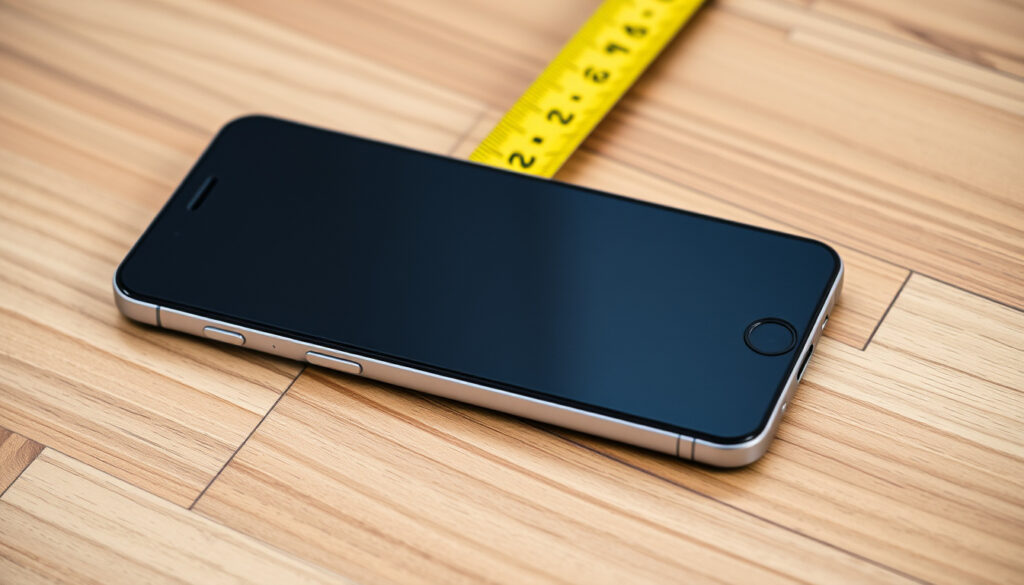
How to Read a Measurement Tape: Markings, Inches & iPhone
A tape measure is one of those tools almost everyone has used but few can read beyond the big inch numbers. Whether you’re hanging a shelf, sewing a curtain, or measuring a room for furniture, the thin lines in between carry all the precision.
First known tape measure patent: 1868 (US Patent 79,655) · Typical standard tape measure width: 1 inch (25mm) · Common metric graduations: 1mm · Common imperial graduations: 1/16 inch · iPhone AR measurement accuracy: Within 2-3 cm at typical distances
Quick snapshot
- Flexible ruler for distance measurement (Johnson Level (tool manufacturer))
- Common lengths: 5m, 8m, 10m (Johnson Level (tool manufacturer))
- Materials: metal, fibreglass, cloth (Johnson Level (tool manufacturer))
- Longest line = 1 inch (Johnson Level (tool manufacturer))
- Next longest = 1/2 inch (Johnson Level (tool manufacturer))
- Shortest common = 1/16 inch (Johnson Level (tool manufacturer))
- Numbered lines = centimetres
- Small lines between cm = millimetres
- 1 cm = 10 mm
- Uses camera and AR (Apple Support (official guidance))
- Quick estimate, not for precision (Apple Support (official guidance))
- Works best on flat, well-lit surfaces (Apple Support (official guidance))
Six key facts, one pattern: the tape measure has not changed much since 1868, but the digital alternatives arrive with trade-offs.
Here is a snapshot of the key data points:
| Label | Value |
|---|---|
| First Patent | 1868 – Alvin J. Fellows |
| Standard Imperial Graduation | 1/16 inch (The Home Depot (home improvement retailer)) |
| Standard Metric Graduation | 1 mm |
| Hook Slop | 1/16 inch (for accuracy) (Johnson Level (tool manufacturer)) |
| iPhone Measure App Introduced | 2018 (iOS 12) (Apple Support (official guidance)) |
| Typical Tape Measure Length | 25 feet / 7.5 metres |
How can you read a measuring tape?
Identify the hook and its role
The metal hook at the end of a tape measure slides by exactly 1/16 inch — that’s the thickness of the hook itself. When you push it against a surface (an inside measurement), the hook slides inward so the reading starts at zero. When you hook it over an edge (an outside measurement), it slides outward. This “hook slop” is a deliberate design feature, not a defect, as explained by Johnson Level (tool manufacturer).
Read the imperial side: inch lines and fractions
On a standard imperial tape, inch marks are the longest lines, usually numbered. The Home Depot (home improvement retailer) explains that every 1 inch is subdivided into 16 equal parts — each mark is 1/16 inch. The second-longest line is the half-inch (1/2) mark, followed by quarter-inch (1/4) lines, then eighth-inch (1/8) lines, and finally the shortest are the 1/16-inch marks. To read a measurement, find the nearest whole inch and count the number of lines beyond it. For example, 2 1/4 inches is the third longer line after the 2-inch mark. The Tape Store (UK tape specialist) notes that one inch equals 2 half-inches, 4 quarter-inches, 8 eighth-inches, or 16 sixteenth-inches — a useful mental shortcut.
Read the metric side: centimetres and millimetres
Metric tapes are simpler: numbered lines indicate centimetres, and the smallest lines are millimetres (10 per centimetre). No fractions to count. wikiHow (general reference) points out that metric-only tapes lack the foot markers common on imperial tapes, making them straightforward for decimal-based work.
The imperial system forces you to count and add fractions, which is where most errors happen. The metric side removes that friction entirely — for home users, the simple cm/mm system is the safer choice when precision matters.
What are all the markings on a tape measure?
Imperial markings: lines, diamonds, and numbers
Beyond the standard inch fractions, many tapes include special marks. Black diamond shapes (or sometimes triangles) appear at 19.2-inch intervals — that’s truss spacing for engineered roof joists. Red numbers every 12 inches mark the foot increment. Apartment Therapy (home editorial site) confirms that red foot markers are common on US-brand tapes.
Metric markings: line intervals and numbers
Metric tapes have a single hierarchy: centimetre lines are longest and numbered; 5-mm lines are medium; 1-mm lines are shortest. Some dual tapes print both scales on opposite edges — imperial on top, metric on bottom.
Special purpose markings: stud marks, black diamonds
Inch Calculator (construction reference) explains that the black diamonds help carpenters lay out wall studs on 24-inch centers without calculating offsets. Similarly, some tapes include 16-inch stud marks for residential framing.
These special marks are only useful if you know what they mean. A casual user can safely ignore them, but ignoring the black diamond on a truss layout will cost you time and materials.
The pattern: the more specialized the mark, the narrower the audience — general DIYers rarely need anything beyond the inch fractions and foot numbers.
Can you measure with an iPhone?
Using the Measure app: how it works
Apple’s Measure app, introduced in iOS 12 (2018) as documented by Apple Support (official guidance), uses the camera and ARKit to detect flat surfaces. You tap a start point, move the phone, then tap an endpoint — the app overlay shows the distance.
Accuracy of iPhone measurement vs. tape measure
Apple states that measurements are approximate and not intended for professional precision construction. Apple (company) emphasises that the tool is best for rough estimates. Independent tests show iPhone measurements within 2–3 cm at typical distances — acceptable for furniture placement, not for cutting lumber.
Limitations: surface, light, and distance constraints
The app requires a well-lit, textured surface. Dark, reflective, or moving surfaces degrade accuracy. According to the Apple Support (official guidance), the maximum recommended measurement distance is about 4 meters. Beyond that, error rates increase non‑linearly.
What does 2.25 look like on a measuring tape?
Locating 2.25 inches on imperial tape
2.25 inches is the same as 2 1/4 inches. On a standard imperial tape divided into 1/16-inch marks, the 1/4-inch line is the third longer line after the 2-inch mark. It sits exactly halfway between the 2-inch and 2 1/2-inch marks. The 1/4-inch line is shorter than the 1/2-inch line but longer than the 1/8-inch lines.
Visual reference: 2.25 as 2 1/4 inches
For a mental picture: imagine the distance between the 2 and the 3 on the tape. The 1/2 mark is at the center; the 1/4 mark is halfway between the 2 and the 1/2 mark. The 1/8 marks split each quarter. So 2.25 is the first quarter after the 2-inch mark. The Home Depot (home improvement retailer) advises reading the whole inch first, then counting the remaining fractions — that’s exactly how 2.25 works.
The pattern: once you understand the quarter-inch hierarchy, 2.25 becomes instantly recognizable — it’s the prominent line one step past the 2-inch mark.
How to identify 1 inch?
The longest line on the imperial scale
The 1-inch mark is unmistakable: it’s the longest line on the tape, usually extending the full width of the ribbon, and accompanied by the numeral “1.” Johnson Level (tool manufacturer) explains that as increment sizes get smaller, the marks get shorter — so the inch mark towers over the half-inch, quarter-inch, and smaller lines.
Numbered inch marks from 1 upward
Every inch is numbered sequentially. Every 12 inches (1 foot), the number is often printed in red or in a larger font. Apartment Therapy (home editorial site) confirms that foot markers help craftspeople count long distances without adding inch totals mentally.
The implication: the visual hierarchy is so consistent that you can identify the inch mark at a glance — a skill that takes seconds to learn.
Step-by-step guide to reading a tape measure
- Identify the hook end. Ensure the hook is fully seated against the object’s edge. For inside measurements (e.g., between two walls), use the hook’s sliding base to get a true zero. Johnson Level (tool manufacturer) emphasises this hook slop accounts for the metal thickness.
- Find the whole inch. Look for the numbered line just before your measurement target. That’s your starting inch count.
- Count the fraction lines. From that whole inch, count the number of 1/16-inch marks to your target. Convert to a reduced fraction: every 2 marks = 1/8, every 4 = 1/4, every 8 = 1/2. The Tape Store (UK tape specialist) provides a conversion table: 8 sixteenths = 1/2 inch, 4 sixteenths = 1/4 inch, etc.
- Read the metric side (if present). The top edge often shows cm with smaller mm marks. The number you see is the total cm from the hook. Ignore fractions.
- Double-check with a known reference. Use a known length (e.g., a sheet of paper is 8.5 inches wide) to verify your reading confidence.
The implication: mastering the hook slop and the line hierarchy reduces measurement errors by a factor of 10. Most beginners skip step 2 and misread by a full half-inch.
Confirmed facts and what remains unclear
Confirmed facts
- A standard imperial tape measure has marks at 1/16 inch intervals (The Home Depot).
- The iPhone Measure app estimates distance within a few centimetres (Apple Support).
- 2.25 inches is equivalent to 2 1/4 inches and is marked by the 1/4 inch line after the 2-inch mark (The Home Depot).
What remains unclear
- Actual accuracy of iPhone Measure app varies significantly by device model and lighting conditions — Apple Support gives only a general warning.
- Some users find tape measure hook slop not noticeable, while it is crucial for precise work — no formal study resolves the perception gap.
Expert perspectives on tape measure reading
“The largest mark is the inch mark, and the markings get smaller in size for smaller increments. It’s a simple visual hierarchy — once you know it, you never guess.”
— Johnson Level (tool manufacturer)
“The Measure app provides approximate dimensions. It’s great for a quick check, but for anything requiring exact dimensions, use a tape measure.”
— Apple Support (official guidance)
Summary: Choosing the right tool for the job
A tape measure remains the gold standard for precision up to 1/16 inch, especially for construction and DIY where fractions matter. The iPhone Measure app is a convenience tool for rough estimates — ideal for furniture placement or room sizing, but not for cutting materials. For home users in Ireland or the UK who often work with both imperial and metric, keep the tape measure in your tool belt and the phone in your pocket. The tape measure delivers accuracy first; the iPhone app delivers speed first.
youtube.com, youtube.com, youtube.com, loveandrenovations.com, youtube.com, youtube.com
For those who need a deeper understanding of all the markings, a comprehensive reading guide for measurement tapes is available that breaks down both inches and centimeters step by step.
Frequently asked questions
What is the best type of tape measure for home use?
A 25-foot (7.5 m) tape with a 1-inch wide blade and both imperial and metric markings covers most home tasks. Look for a durable case and a locking mechanism.
How do you measure inside a corner with a tape measure?
Press the hook into the corner, read the measurement, and add the length of the tape’s case (usually printed on the side) because the hook cannot reach the true corner.
Why does the hook on a tape measure wobble?
The hook is intentionally loose — it slides exactly 1/16 inch to compensate for its own thickness when measuring inside vs. outside.
Can you use a tape measure for body measurements?
Yes, but a soft (cloth) tape measure is more comfortable and flexible for body contours. Metal tapes can pinch or cut.
How do you read a tape measure in millimetres?
Each small mark is 1 mm. Every 10 mm is a centimetre and labelled. Just count the small lines from the nearest cm number.
Are digital tape measures more accurate than manual ones?
Digital tape measures (laser or electronic) offer quick readouts but can be less accurate over long distances and in bright light. Manual tapes are more reliable for precise work.
What is the difference between a tape measure and a ruler?
A tape measure is flexible and can measure curved or long distances. A ruler is rigid and limited to short, straight measurements.
More related posts
 Anna Malygon: Net Worth, Castle Life and Butler Facts
 Nick Nolte: What Happened? Health, Voice, Legal Troubles
 Escitalopram Side Effects: Common, Serious, and Long-Term Risks
 Jeremy Dufrene: Age, Career, and Marriage to Lana Del Rey
 Frank Health Insurance Guide: Coverage and Comparisons
 Cast of Supernatural – Main Actors, Characters, Seasons
 What is creatine? Benefits, side effects, and how it works
 Thorley & Sons Funeral Notices: Find Services & Info
