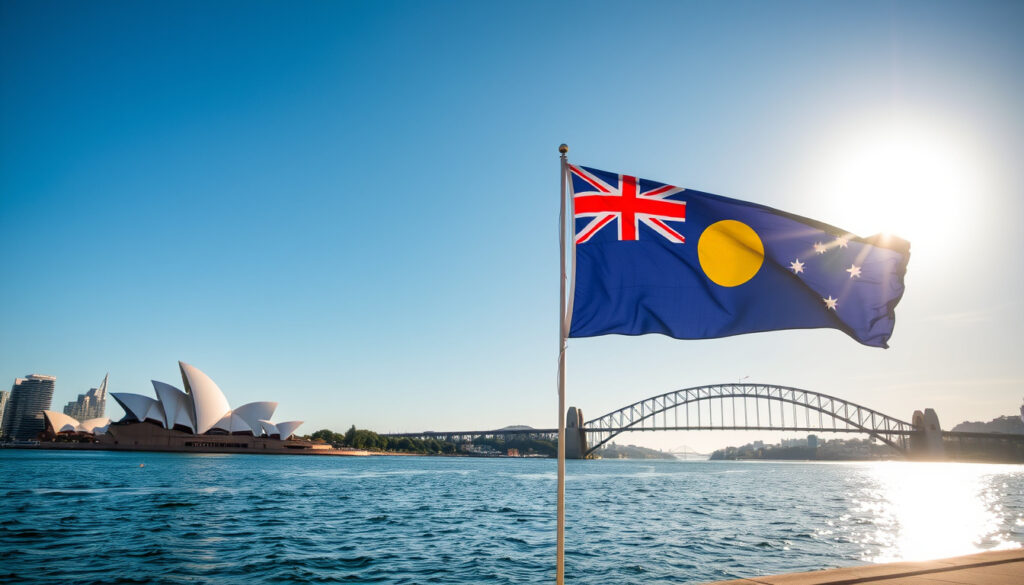
Australia Day 2025: Date, History, Events, and Controversy
Few dates on the Australian calendar spark as much conversation as 26 January. Whether you see it as a day for barbecues and citizenship ceremonies or a solemn reminder of colonisation, Australia Day 2025 lands on a Sunday, bringing the familiar mix of celebration, controversy, and reflection. The debate over the date is louder than ever, with over 300 events planned across the country and protests expected alongside them.
Annual observance: 26 January ·
Historical basis: First Fleet arrived 26 January 1788 ·
Recognition: National public holiday since 1994 ·
Community participation: Over 300 events across Australia ·
Controversy: Many Aboriginal Australians refer to it as Invasion Day
Quick snapshot
- Australia Day is the national day of Australia celebrated on 26 January (Common Ground (First Nations education platform))
- It marks the arrival of the First Fleet at Sydney Cove in 1788 (Insider Guides (student resource provider))
- In 2025, Australia Day falls on Sunday 26 January (Common Ground (First Nations education platform))
- It is a public holiday in all states and territories (Common Ground (First Nations education platform))
- Whether the date will change in the future remains uncertain
- Exact number of protest participants is not reliably counted
- First Fleet arrival: 26 January 1788 (Common Ground)
- First formal celebration: 1808 (Go Study Australia (education guide))
- National public holiday established: 1994 (Insider Guides)
- Growing protests and change-the-date movement: 2017 onward (Common Ground)
- 26 January 2025: Australia Day celebrations and counter-protests expected across major cities (Insider Guides)
- Ongoing political debate about potential date change (Insider Guides)
Six key facts about Australia Day 2025, one pattern: the day is simultaneously a statutory holiday and a flashpoint for national identity.
| Label | Value |
|---|---|
| Date | 26 January |
| 2025 Day of Week | Sunday |
| First Fleet Arrival | 26 January 1788 |
| Public Holiday Status | Yes, national |
| Number of Events | Over 300 |
| Alternative Name (by some) | Invasion Day |
The implication: the official facts tell only part of the story — the lived experience of the date diverges sharply depending on who you ask.
What is Australia Day?
Australia Day is the official national day of Australia, observed annually on 26 January (Go Study Australia (education guide)). It marks the anniversary of the 1788 arrival of the First Fleet and the raising of the British flag at Sydney Cove under Captain Arthur Phillip (Common Ground (First Nations education platform)). The day has been celebrated since 1808 and became a national public holiday in 1994 (Insider Guides (student resource provider)). In 2025, it falls on Sunday 26 January, making it a public holiday across all Australian states and territories.
When is Australia Day 2025?
Australia Day 2025 is on Sunday 26 January. Because the date falls on a weekend, the public holiday is observed on the Monday in some states — check your state government website for exact rules. For most Australians, it means a long weekend.
Is Australia Day a public holiday in 2025?
Yes, Australia Day is a public holiday in all states and territories in 2025. However, some states and territories have made adjustments in recent years. For example, some employers observe the holiday on the following Monday when the date falls on a weekend. The Fair Work Ombudsman (Australia’s workplace regulator) provides detailed guidance on public holiday rules.
What events are planned for Australia Day 2025?
Events for Australia Day 2025 include the Australia Day Live concert in Sydney, citizenship ceremonies, community barbecues, beach cricket, and fireworks displays across major cities (Remitly (lifestyle and migration platform)). Over 300 community events are expected nationwide, coordinated through local councils and the Australia Day Council. Sydney Harbour typically hosts the largest celebrations, including ferry parades and aerial displays.
The sheer scale of events — over 300 planned — shows that for many Australians, the day remains a genuine celebration of community and national identity. But the same number highlights the challenge: no alternative date has yet matched this level of grassroots participation.
Why is Australia Day on 26th January?
The date 26 January was chosen because it marks the day in 1788 when Captain Arthur Phillip raised the Union Jack at Sydney Cove, declaring the land a British colony (Common Ground (First Nations education platform)). What began as an informal anniversary among early settlers became a formal celebration by 1808, when the first recorded observance took place (Go Study Australia (education guide)). By 1935, all Australian states and territories had adopted the name Australia Day
for 26 January (Insider Guides (student resource provider)). It took until 1994 for the date to become a uniform national public holiday, ending the previous practice where some states observed it on a Friday for a long weekend (Wikipedia (online encyclopedia)).
What happened on 26 January 1788?
On 26 January 1788, the First Fleet of 11 ships carrying around 1,400 people — convicts, marines, and officers — arrived at Warrane (Sydney Cove) after eight months at sea. Captain Arthur Phillip raised the British flag, formally claiming the land for the British Crown (Common Ground (First Nations education platform)). For the Aboriginal peoples who had occupied the continent for over 50,000 years, this marked the beginning of colonisation, dispossession, and violence (Insider Guides (student resource provider)).
The pattern: a date that began as a British colonial landmark evolved into a national holiday, but the historical rupture it represents has never healed.
What happened to Aboriginal people on the 26th of January?
For Aboriginal and Torres Strait Islander people, 26 January does not mark a celebration — it marks the beginning of a long and brutal colonisation of both people and land (Common Ground (First Nations education platform)). Many Indigenous Australians refer to the date as Invasion Day or Survival Day, and observe it through mourning ceremonies, protests, and educational events (National Today (calendar observance guide)).
Why is Australia Day controversial for Indigenous Australians?
The controversy stems from the fact that 26 January directly commemorates the beginning of colonisation, which led to massacres, land theft, forced removal of children, and systematic destruction of Aboriginal culture. Australia Day celebrations are not generally embraced by Aboriginal and Torres Strait Islander people and some non-Indigenous people (Common Ground (First Nations education platform)). For many, having a public holiday on that date feels like celebrating an invasion.
What is Invasion Day?
Invasion Day is the term used by many Aboriginal Australians and their allies to reframe 26 January as a day of mourning rather than celebration. Protests and rallies are held annually in cities including Sydney, Melbourne, Brisbane, and Canberra. The movement also calls for changing the date of Australia Day to one that all Australians can celebrate together (Common Ground (First Nations education platform)). Proposed alternative dates include 1 January (Federation anniversary) and 27 May (1967 referendum, start of Reconciliation Week) (Insider Guides (student resource provider)).
A date meant to unify the nation instead highlights its deepest division. The same flag raised in 1788 is now carried by protesters on both sides — those celebrating it and those mourning what it represents. For policymakers, the question is no longer if the date should change, but what would replace it.
Is it racist to say aborigine?
The term Aborigine
is considered outdated and potentially offensive by many Aboriginal Australians (Insider Guides (student resource provider)). The preferred terms are Aboriginal Australian
, Indigenous Australian
, or — best of all — the specific nation or language group name (e.g., Gadigal, Wiradjuri, Yolngu). Using respectful language is more than politeness; it acknowledges the diversity of the hundreds of distinct Aboriginal nations that existed prior to colonisation.
What is the preferred term for Indigenous Australians?
When referring to Australia’s First Peoples, use Aboriginal and Torres Strait Islander peoples
(capitalised) for the collective. For individuals, use the specific nation name if known. The term Aborigine
with a lowercase a
is widely seen as pejorative. Common Ground, a First Nations-led education platform, recommends the term First Nations
as a respectful alternative (Common Ground (First Nations education platform)).
The implication: language choices reflect whether you see 26 January as a celebration or a wound — and getting it right is a small but meaningful step toward reconciliation.
What’s the friendliest town in Australia?
Surveys and travel guides frequently name Port Douglas (Queensland), Coffs Harbour (NSW), and Broome (Western Australia) among the friendliest towns in Australia. These rankings are based on visitor reviews, community engagement, and hospitality metrics. While not directly related to Australia Day, these destinations often host major Australia Day events.
What is the silent killer in Australia?
In public health contexts, the silent killer
in Australia most commonly refers to asbestos-related diseases — Australia has one of the highest rates of mesothelioma in the world due to historical asbestos mining and construction use. Heart disease and high blood pressure are also frequently described as silent killers because they can develop without obvious symptoms.
Which animal is found only in Australia?
Australia is home to many endemic species found nowhere else on Earth. The most iconic are the kangaroo, koala, platypus, wombat, echidna, and Tasmanian devil. The platypus is particularly notable as one of the few egg-laying mammals (monotremes) in the world.
How do you say ‘hi’ in Australian?
The most common informal Australian greeting is G’day
(short for good day
), often paired with mate
. Other casual greetings include how ya goin’?
(how are you going?) and what’s up?
— delivered with the famously relaxed Australian drawl.
What is the number one crime in Australia?
Property crime — including theft, burglary, and vehicle theft — consistently ranks as the most common crime category in Australia. According to the Australian Bureau of Statistics, rates vary significantly by state and territory, with property crime being more prevalent than violent crime in most regions.
The pattern: these tangential questions reveal that readers searching for Australia Day information are also curious about Australian culture, geography, and everyday life. A comprehensive guide needs to address both the core topic and its broader context.
Timeline: Key dates in Australia Day history
Five moments define the arc of Australia Day from British landing to national flashpoint.
- — First Fleet arrives at Sydney Cove; Captain Arthur Phillip raises the Union Jack and claims the land as a British colony (Common Ground).
- — First formal celebration of the date recorded (Go Study Australia).
- — All Australian states and territories adopt the name
Australia Day
for 26 January (Insider Guides). - — Australia Day becomes a uniform national public holiday across all jurisdictions (Wikipedia).
- — Growing protests, change-the-date campaigns, and public debate intensify; events such as the Invasion Day rallies draw increasing attendance (Common Ground).
What this means: the timeline shows a holiday that evolved slowly over two centuries, but the last decade has compressed that history into a fierce public reckoning. The question facing Australia Day 2025 is whether the next timeline entry will show a new date or a deeper fracture.
Frequently asked questions
Is Australia Day a public holiday in all states?
Yes, Australia Day is a public holiday in all Australian states and territories. In 2025, it falls on Sunday 26 January, and in some states the public holiday is observed on the following Monday. Check your state government’s website or the Fair Work Ombudsman for specific rules.
What time do Australia Day fireworks start in Sydney?
Australia Day fireworks in Sydney typically start around 8:30–9:00 PM local time on 26 January. The exact schedule is announced closer to the date on the official Australia Day website.
What is the meaning of Australia Day?
Australia Day is officially the national day of Australia, commemorating the 1788 arrival of the First Fleet. However, its meaning is deeply contested: for many it celebrates Australian identity and achievement, while for Aboriginal Australians it marks the beginning of colonisation and dispossession (Common Ground).
How do Australians celebrate Australia Day?
Common celebrations include community barbecues, beach cricket, citizenship ceremonies, fireworks displays, and the Australia Day Live concert (Remitly). Many Australians also use the day to award community honours and present flags to new citizens.
Are there any Australia Day 2025 concerts?
Yes, the Australia Day Live concert is traditionally held at the Sydney Opera House and Sydney Harbour, featuring performances by Australian artists. Details for 2025 will be confirmed closer to the date.
What is the history of the Australia Day date?
The date 26 January was chosen because it marks the 1788 arrival of the First Fleet. It was first celebrated informally, became known as Australia Day
across all states by 1935, and was made a national public holiday in 1994 (Insider Guides).
Related reading
For Australians deciding how to spend 26 January 2025, the choice is clear: engage with the day thoughtfully — whether through celebration, protest, or quiet reflection — or risk letting the date continue to divide rather than unite.
More related posts
 ABC News Australia: Trusted News & Public Broadcasting Guide
 Shahid Kapoor Biography: Relationships, Age, Net Worth
 Valentin Vacherot: ATP Ranking, Age, Family, Partner & Career
 Francesca Bridgerton: Recast, Love Story & Future
 Someone You Loved – Lewis Capaldi True Meaning and Lyrics
 Lisa Millar: ABC Journalist, Partner, Weight Loss & Career
 Attila the Hun: Biography, Empire, Death, and Legacy
 Eddie Hall Net Worth, Career, and Tommy Fury Fight
